
By Sola Adebawo
IT is easy to talk about insecurity in Nigeria as though it has a fixed address. Up north. Rural. Violent. Armed. What is harder to see—perhaps because it comes without gunfire—is the quieter insecurity unfolding in our cities. The kind that arrives with notices taped to walls, bulldozers at dawn, and families scrambling for what they can carry.
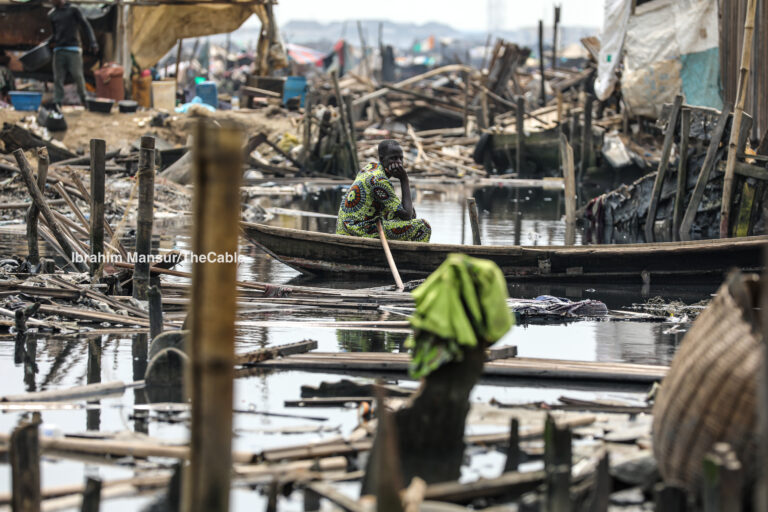
Recent mass evictions in Lagos, particularly in waterfront communities such as Makoko, force an uncomfortable question into the open: are Nigerian cities being developed for people, or curated for appearance?
Thousands have lost their homes—not because of floods or fire, but policy. Families displaced overnight. Children pulled out of school. Livelihoods erased in a single afternoon. In some cases, infants sleep in makeshift shelters by the lagoon. This is not an accident of development. It is becoming a governing pattern.
The insecurity we do not name
When we talk about security, we often mean armed threats. But security also means predictability. Stability. The confidence that the ground beneath you will still be yours tomorrow. Urban displacement destroys that quietly.
A man who loses his home does not show up in terrorism statistics. A woman who loses her market stall does not feature in crime dashboards. Yet these are the conditions that fracture families, push young people into survival economies, and hollow out trust in public institutions.
READ ALSO: https://stonixnews.com/side-chicks-and-the-quiet-shortening-of-mens-lives/
Displacement is not the absence of security. It is its delayed form.
Development, but for whom?
Governments understandably want modern cities: clean skylines, waterfront regeneration, investment-friendly environments. These goals are not inherently wrong.
The problem begins when development is imagined as something that must first remove people in order to succeed.
Informal settlements are treated as obstacles rather than communities; as inconveniences rather than contributors. Decades of residence are reduced to a planning problem. Citizenship becomes conditional on formal documentation that the poorest were never designed to possess.
The question hanging over Makoko is not whether Lagos should develop, but who development is allowed to inconvenience—and who it is allowed to erase.
Lawful does not always mean legitimate
Defenders of mass evictions often lean on legality. Notices were served. Court orders obtained. Regulations enforced. But legality is a narrow standard for justice. When notice periods are unrealistic, compensation nonexistent, and resettlement plans vague or absent, the law becomes a shield rather than a safeguard. It is technically compliant, but socially brittle.
A state that governs only through enforcement, without empathy or inclusion, may maintain order in the short term. But it quietly accumulates resentment—and resentment has a long memory.
The politics of visibility
There is an aesthetic politics at work here. Cities are being shaped for those they wish to attract, not those who already live there. Waterfronts are cleared for future investors. Poverty is pushed out of sight, not addressed.
The irony is painful. Nigeria’s economic engine depends on informal labour—transport, food supply, domestic work, construction. Yet the people who keep the city running are treated as temporary guests in their own lives.
When development is driven by optics, it creates beautiful cities that feel emotionally uninhabitable.
Lagos is not an exception. It is a signal.
What is happening in Lagos is not unique; it is simply more visible.
Urban centres across Nigeria are absorbing people displaced by rural insecurity, climate stress, and economic stagnation. Cities are swelling faster than planning systems can handle. Instead of adapting, the response is often demolition.
This creates a loop: rural insecurity drives urban migration; urban displacement creates new forms of instability. Those displaced move again, further straining already fragile spaces.
We are not solving problems. We are relocating them.
What a different approach could look like
This is not an argument against urban renewal. It is an argument against renewal without people.
Other cities have shown alternatives: incremental upgrading of informal settlements; community-led redevelopment; phased relocation with guaranteed resettlement; compensation that reflects real economic loss, not token payments.
These approaches are slower. Messier. Politically less dramatic.
But they build trust—and trust is infrastructure too.
The deeper cost
At its core, displacement is not just about housing. It is about belonging.
When citizens feel expendable, they disengage. They stop believing in planning processes. They stop trusting promises. And eventually, they stop seeing the state as something that exists for them.
Nigeria does not suffer from a lack of ambition. It suffers from a habit of choosing speed over inclusion, spectacle over stability.
Development that displaces without care does more than remove homes.
It erodes legitimacy.
And no city—no matter how modern its skyline—can stand for long on eroded trust.
Sola Adebawo is an accomplished business leader and communications expert with extensive experience in the oil and gas industry. He currently serves as General Manager, Government, Joint Venture and External Relations at Heritage Energy. Adebawo is also an author, scholar and ordained minister, known for his writings on socio-economic issues, strategic communication and leadership.

Follow Stonix News
Stay updated with our latest news and updates:
📢 WhatsApp Channel:
Join our WhatsApp Channel
📘 Facebook:
Follow us on Facebook
🎵 TikTok:
Follow us on TikTok
▶️ YouTube:
Subscribe to our YouTube Channel