

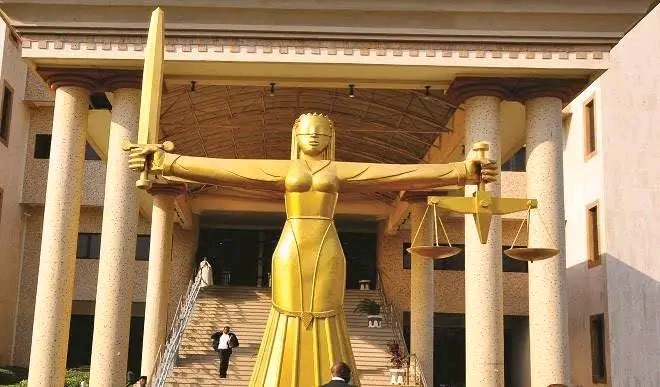
HUMAN rights lawyer Deji Adeyanju on Monday appeared before the Federal High Court in Abuja as a prosecution witness in the ongoing trial of former Kaduna State Governor, Nasir El-Rufai, who is facing charges bordering on alleged breach of national security.
Mr Adeyanju testified as the second prosecution witness (PW-2) before Justice Joyce Abdulmalik, led in evidence by prosecution counsel Oluwole Aladedoye (SAN) of the Department of State Services (DSS). The defence was represented by Paul Erokoro (SAN).
The trial stems from allegations arising from a television interview in which Mr El-Rufai reportedly claimed he intercepted a telephone conversation involving the National Security Adviser (NSA), Nuhu Ribadu. The alleged conversation was said to contain instructions to security operatives to arrest him.
Mr El-Rufai also linked the purported directive to an incident at the Nnamdi Azikiwe International Airport on 12th February, shortly after returning from Cairo, Egypt, where he claimed he was targeted for arrest. The DSS subsequently instituted charges against him, accusing him of making statements considered capable of undermining national security.
When the case was called on Monday, Mr Adeyanju presented the subpoena through which he was summoned to testify. The prosecution sought to tender the document, and it was admitted without objection from the defence, marked as Exhibit G.
The court also admitted additional documentary and digital evidence, including Mr Adeyanju’s recorded interview and a certificate of compliance, which were marked as Exhibits H and H1. A flash drive containing the interview was played in open court after the application was granted and not opposed by the defence.
In his testimony, Mr Adeyanju recalled that on 12th February, reports circulated suggesting that Mr El-Rufai was either to be arrested or invited by security agencies. He told the court that prior to the former governor’s televised remarks, he had publicly advised him to submit himself for investigation, stressing that the matter was not politically driven.
Mr Adeyanju further stated that he appeared on a television programme on 13th February—the same day Mr El-Rufai granted the controversial interview forming the basis of the charges.
“I went to Arise, and El-Rufai was also on the show. My segment came after his. During his interview, I listened to him speak on many issues, and I countered many of the things he said because they were not true or were half-truths,” he told the court.
The court later reviewed both Mr El-Rufai’s interview and Mr Adeyanju’s response as part of the evidence.
In the recorded broadcast, Mr Adeyanju told anchor Charles Aniagolu that he did not believe Mr El-Rufai was in danger of an unlawful airport arrest, arguing that security agencies would have acted earlier if that were the case. He also referenced claims that the Independent Corrupt Practices and Other Related Offences Commission (ICPC) was investigating the former governor at the time.
According to him, Mr El-Rufai’s presence at the airport suggested he was already under security observation, adding that “once your name is there, the first thing is to confiscate the passport.” He further argued that no persecution was taking place, insisting that Mr El-Rufai should be investigated over alleged corruption and that any prosecution should follow due process.
Mr Adeyanju also made broader comments about Mr El-Rufai’s tenure as governor, accusing him of human rights violations and describing current allegations of persecution against him as inconsistent with his past actions. He added that the former governor’s present situation amounted to “karma.”
Following the broadcast, Mr Adeyanju told the court that he was invited by the DSS to make a statement. He said he complied and later “reluctantly” provided a written account of his understanding of events. The statement was tendered in evidence and marked as Exhibit E after he confirmed its contents in court.
During cross-examination, defence counsel Paul Erokoro (SAN) questioned Mr Adeyanju on whether Mr El-Rufai explicitly said he “tapped” a phone conversation. Mr Adeyanju responded that what he heard was the statement: “We listened to their calls.”
When pressed further on the interpretation of the alleged interception, the witness maintained that he would report any claim of hacking or interception but admitted he did not know how any alleged access to calls occurred.
The defence argued that hearing a conversation on speakerphone does not constitute interception or tapping—a point the prosecution challenged as irrelevant to the core testimony. Mr Adeyanju also told the court that he had no personal opinion on technical aspects of the allegation, stating that his role was limited to what he observed and said during the broadcast.
Justice Joyce Abdulmalik adjourned the matter until 23rd June for continuation of the trial.
Follow Stonix News
Stay updated with our latest news and updates:
📢 WhatsApp Channel:
Join our WhatsApp Channel
📘 Facebook:
Follow us on Facebook
🎵 TikTok:
Follow us on TikTok
▶️ YouTube:
Subscribe to our YouTube Channel


