Ademola Ajao, Reporting
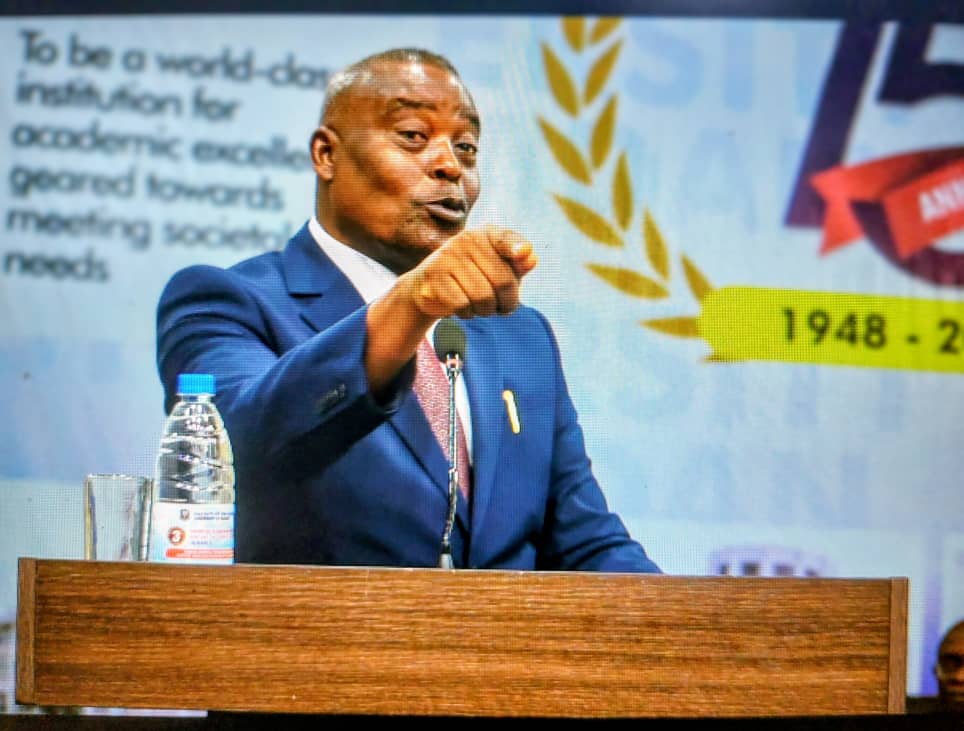
IBADAN — The Director-General of the Nigerian Institute of International Affairs (NIIA), Professor Eghosa Emmanuel Osaghae, has declared that digital transformation transcends all geographical and institutional boundaries, challenging traditional approaches to academic research and learning.
Professor Osaghae made the assertion on Wednesday while delivering the keynote address at the Annual Ibadan International Social Science Conference (ALLSSC), organised by the Faculty of the Social Sciences at the University of Ibadan.
The event, held at Trenchard Hall, explored the theme: “Digital Transformation, Social Justice, and Sustainability in a Dynamic World.”
In his address, the NIIA chief challenged the conventional methods of postgraduate research, arguing that the digital age renders traditional library-based study increasingly obsolete. He revealed that his own researchers often produce similar findings because they rely on the same physical archives.
“You don’t need to go to Kenneth Dike Library for your PhD anymore,” Professor Osaghae stated. “You can sit in the comfort of your room and write a thesis.”
Drawing comparisons with global leaders in technological innovation, he noted that China had already recognised the imperative to adapt. “They concluded that they would be in trouble if they pretend that this digital transformation is not charging the world of learning. So, for PhD, we are no longer going to tell you to write a thesis anymore. If you are in engineering they will ask you if you have thought of a problem you want to solve. Think of a technical solution to it and come and defend it.”
The professor also offered a sobering reflection on the nature of knowledge itself. “In the social sciences we already know that there is no knowledge that is new. Everything you think is new and unknown to you is because you haven’t read enough. If you read enough you will find out that as long as 100 years ago, someone had already thought about what you are thinking of.”
Professor Osaghae emphasised that digital transformation extends far beyond the realms of Artificial Intelligence and robotics, beginning fundamentally with how data is stored and managed. He contrasted modern practices with the analogue past, where researchers relied on “a pile of paper.”
However, he also sounded a cautionary note regarding the rise of automation. “How do we create accountability?” he asked. “Because if those machines are fully automated, they can have a life of their own entirely and they will not be accountable to anybody.”
He stressed that all algorithmic creations remain inherently human-made. “There is no way it can run faster than us. We have to be proactive by having a radical shift in the way we think.”
Addressing concerns over data sovereignty, Professor Osaghae urged Nigerians to critically assess their reliance on foreign digital infrastructure. “If we are going to have technical solutions, digital transformation will help us but we must create our own spaces. When we have meetings in important places we usually say call me on WhatsApp because it is encrypted. It is not encrypted. We can’t talk about data sovereignty when our data is in the cloud,” he concluded.