ANDY Burnham has been formally appointed as Britain’s new Prime Minister, vowing to deliver a 10-year plan to ease cost-of-living pressures and restore political stability to a nation weary of revolving-door leadership.
The 56-year-old Labour leader met King Charles III at Buckingham Palace on Monday to formally accept the role, becoming the country’s seventh prime minister since the start of 2016.
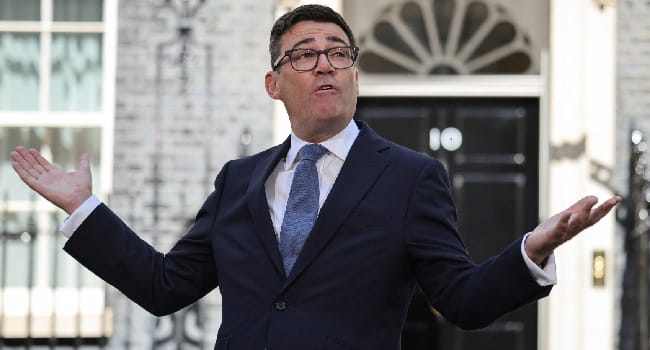
Accompanied by his wife Marie-France van Heel, Burnham arrived at Downing Street to resounding applause from supporters, acknowledging the scale of the challenge ahead as he promised to create “a new political model” and “build a new economy”.
“Britain needs to show the world it can regain stability,” Burnham declared in his first speech outside Number 10. “I will bring forward a new plan for Britain, a 10-year plan.”
The new Prime Minister wasted no time in setting out his immediate priorities, pledging to give Britons “some breathing space now, some help with the cost of living” with announcements due to begin on Tuesday.
His first official instruction will be a commitment to “end rough sleeping” – a measure he previously attempted to implement as regional mayor of Greater Manchester, though with limited success.
Burnham also promised to re-industrialise Britain through public procurement, build more public housing, and decentralise power away from Westminster, declaring his belief that “in the 1980s Britain took some wrong turns”.
“We need to put life’s essentials back under stronger public control to make them affordable,” he added.
The Labour leader’s swift elevation to the top job comes after predecessor Keir Starmer resigned on June 22, with party MPs viewing Burnham as their best hope of countering Nigel Farage’s anti-immigration Reform UK party.
Starmer, who led Labour to a landslide election victory in July 2024 after 14 years of Conservative rule, departed Downing Street earlier insisting his short tenure had made Britain “stronger and fairer than it was two years ago”.
However, his premiership became characterised by a string of scandals, missteps and policy U-turns that ultimately cost him the confidence of his party.
Burnham faces an overflowing in-tray of urgent challenges, including a tepid economy, high government borrowing costs, a ballooning welfare bill, and the ongoing issue of irregular migrants arriving in small boats – a problem that has fuelled support for Reform.
Unpredictable energy prices stemming from the US-Iran war and volatile relations with the United States under President Donald Trump also threaten to buffet his premiership.
The new Prime Minister has little room for manoeuvre amid sluggish economic growth, high public debt and strict financial rules requiring him to balance government spending against tax revenue.
Shortly after entering Downing Street, Burnham held a phone call with President Trump, according to UK and US officials speaking on condition of anonymity.
He also confirmed he would speak with Ukrainian leader Volodymyr Zelensky later Monday, offering reassurance that “I will be with him 100 per cent”.
Rachel Reeves has announced her departure as finance minister, while deputy PM David Lammy confirmed he is also leaving government.
Burnham, who served as an MP between 2001 and 2017 and as a minister under Tony Blair and Gordon Brown, has been nicknamed the “King of the North” for his popular tenure as Greater Manchester mayor.
But his swift “coronation” as Labour leader without a contest – and now Prime Minister by virtue of Labour’s huge parliamentary majority – has raised questions about how he will achieve his ambitious aims. Opposition politicians have already called for a snap election.
International leaders have been quick to offer their congratulations. EU chief Ursula von der Leyen said she looked forward to working with Burnham “to strengthen the EU-UK partnership”, while German Chancellor Friedrich Merz invited him to visit Berlin to mark “the deep bond between us”.
French President Emmanuel Macron also sent his congratulations, urging Burnham to “give new momentum to the partnership between the United Kingdom and the European Union”.
The new Prime Minister’s promise of a “decade of national renewal” echoes similar language used by Starmer before his downfall, leaving many to question whether Burnham can succeed where his predecessor failed.
With a nationwide election due in 2029, time is short for the new leader to make his mark on a nation crying out for stability and direction.
Additional reporting by AFP