
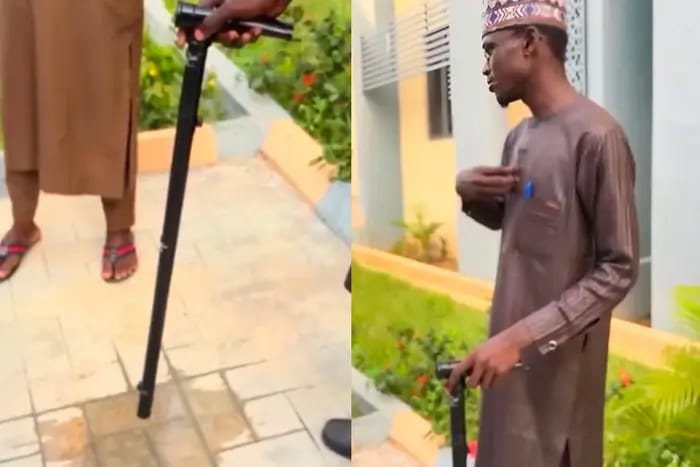
A group of 300-level engineering students at Ahmadu Bello University has developed an electronic walking aid designed to help visually impaired Nigerians navigate their surroundings, with plans to upgrade the device using artificial intelligence.
The innovative device detects obstacles including people, holes and water, using different sounds and vibrations to alert users, offering a potential lifeline for the estimated 24 million Nigerians living with vision loss.
According to the International Agency for the Prevention of Blindness, 24 million people in Nigeria were living with vision loss in 2020, while 1.3 million were blind. Another 50 million Nigerians had non-vision-impairing eye conditions requiring basic eye care services.
In a video demonstration that has since gone viral online, the students showcased their creation and explained how the device works. One of the students revealed that the electronic device produces distinct sounds to notify a visually impaired person about the type of obstacle ahead.
“If I am walking and this is an obstacle, it detects the obstacle and also vibrates in my hand so that I will know there is an obstacle,” he explained during the demonstration.
The device can detect different obstacles — including a person, a hole and water — and uses vibrations to alert the user when an obstacle is detected. During the live demonstration, the student explained that the machine produces different sounds for each type of obstacle.
The students also designed the device with room for further enhancement. According to the student, the team plans to integrate artificial intelligence by adding a camera that can transmit Bluetooth signals to an ear detector. The proposed upgrade would allow the device to tell a visually impaired person the specific type of obstacle in front of them.
Assistive Technology Gap
The innovation comes at a time when assistive technology remains a critical component of helping people living with visual impairment achieve greater independence.
For people living with blindness, existing mobility solutions include white canes, mobility training, Braille and digital assistive technologies. The World Health Organisation notes that assistive technology can support independent and safe mobility and improve participation in education, work and everyday life.
However, access to such technologies remains limited in Nigeria, where the prevalence of vision loss continues to rise. The ABU students’ device represents a locally developed, potentially affordable alternative to imported assistive technologies.
The development has drawn attention to the role of Nigerian universities in fostering homegrown solutions to pressing social challenges, with the students’ initiative demonstrating how engineering education can be applied to address the needs of vulnerable populations.
The planned AI upgrade would represent a significant advancement, potentially transforming the device from a basic obstacle detector into a more sophisticated navigation aid capable of providing detailed environmental information to users.
The students have not yet announced when the upgraded version would be available or whether they plan to commercialise the device.