Ebenezer Adurokiya, Reporting
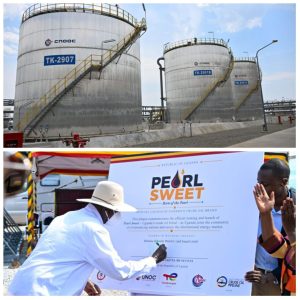
UGANDA has taken another major step towards becoming an oil-producing nation, with President Yoweri Kaguta Museveni officially naming the country’s crude oil “Pearl Sweet Petroleum” ahead of the anticipated commencement of commercial production.
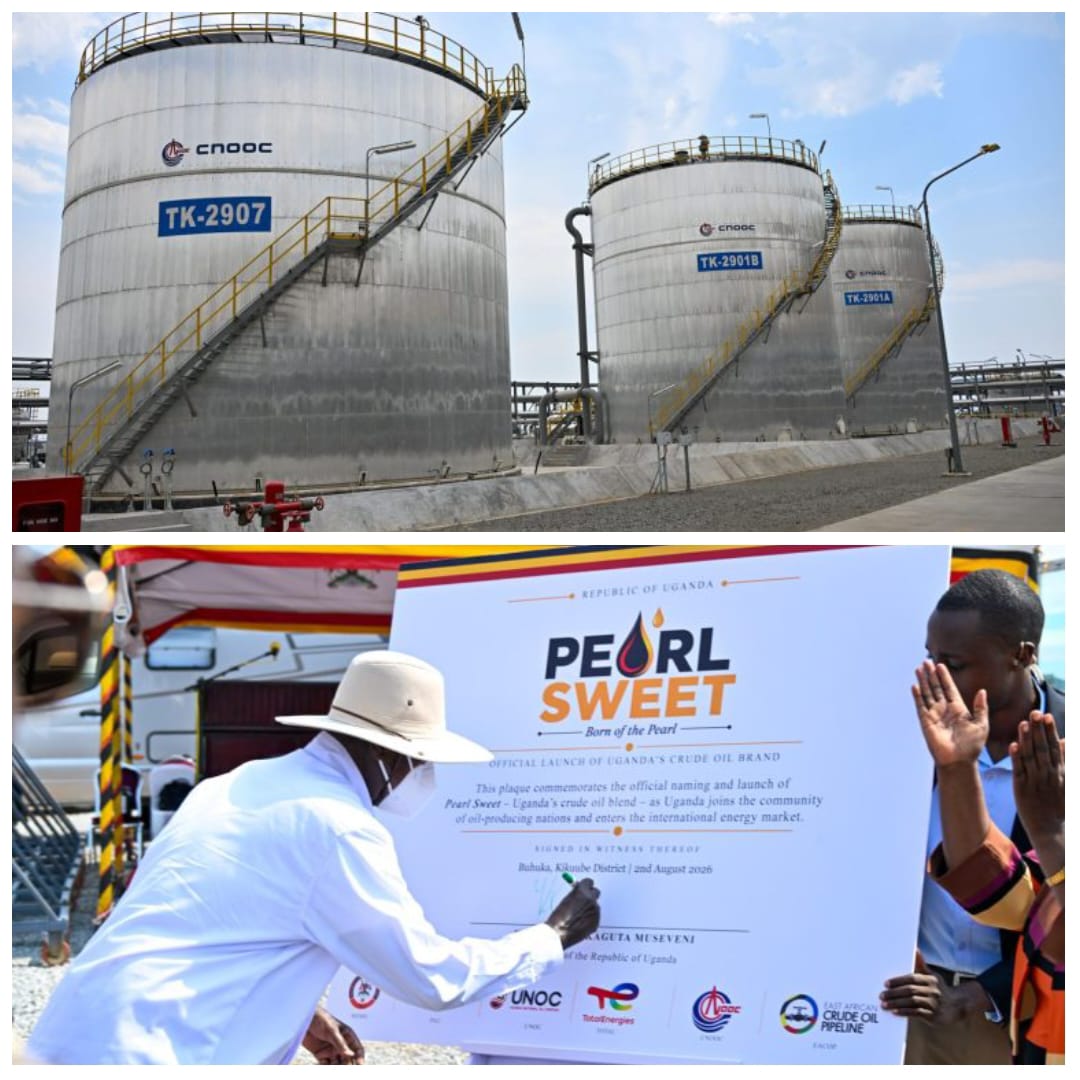
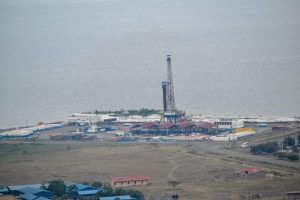
President Museveni unveiled the name on 2 September 2026 during a visit to the Kingfisher Oilfield in Buhuka, Kikuube District, where the project’s Central Processing Facility (CPF) has reached mechanical completion.
The occasion marked more than the naming of Uganda’s crude. It offered a glimpse into the country’s long-awaited transition from oil exploration and development to production, while highlighting the government’s ambitions to use petroleum wealth to accelerate industrialisation and infrastructure development.

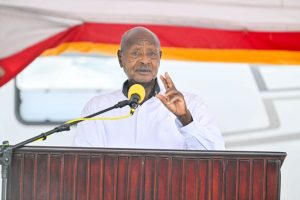
“We are here to celebrate and give this baby (oil) a name,” Museveni said, explaining that the crude had been described as “sweet” because of its very low or negligible sulphur content.
According to Uganda’s Energy and Mineral Development Minister, Dr Monica Musenero, the name combines two elements of the country’s identity. “Sweet” reflects the crude’s low sulphur content, which makes it cheaper to refine, while “Pearl” draws from Uganda’s long-standing description as the Pearl of Africa.
For Uganda, the significance of the moment extends beyond the symbolism of a name.
From Discovery To Production
Uganda’s petroleum industry has been years in the making, moving from exploration and discovery to the development of infrastructure required to bring the resource into commercial production.
At Kingfisher, operated by CNOOC Uganda Limited, preparations for first oil are now at an advanced stage. The Permanent Secretary in the Ministry of Energy and Mineral Development, Eng Pauline Irene Batebe, said the project was about 80 per cent complete, while first-oil readiness had reached 98 per cent.
Commissioning tests are already under way, with first oil expected by the end of September, according to the ministry.
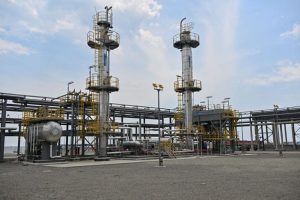
The Central Processing Facility, which has been designed to handle up to 40,000 barrels of crude oil per day, will play a central role in the operation. At the facility, crude oil, water, gas and waste will be separated before each component is directed towards its intended use or treatment.
Of the 31 wells planned for the Kingfisher Development Area, 22 are ready, with some extending more than seven kilometres underground. Pumping and flowback activities are also progressing as the project moves towards production.
The development includes the CPF, four well pads, camps, a supply base and a 47-kilometre feeder pipeline.
A Strategy Beyond Exporting Crude
President Museveni used the visit to underline what he sees as the wider economic purpose of Uganda’s petroleum resources.
Rather than relying solely on crude exports, he said the oil industry should serve as a catalyst for industrial development, infrastructure and productive capacity.
“The petroleum industry would push us very far,” the President said, while pointing to the planned refinery and its potential to produce fuel for vehicles, aviation fuel and other petroleum products.
Museveni has repeatedly argued that Uganda should use its petroleum resources to build industries and durable assets rather than spend oil revenues on consumption and luxury imports.
“The money will be used to do durable things — to build power stations, build the railway and other things which will be there for the grandchildren,” he said.
His position places the planned refinery at the centre of Uganda’s strategy for deriving long-term value from its oil.
Refinery Remains A Priority
Although the East African Crude Oil Pipeline (EACOP) is being developed to transport Uganda’s crude to Tanzania’s Tanga Port, Museveni said the refinery remains a priority.
He argued that refining crude domestically could help Uganda reduce the cost of petroleum products by cutting transportation and transit expenses associated with importing refined products.
The President said transporting crude through the pipeline to Tanga would cost about $12.77 per barrel, while domestic refining would eliminate that transport expense.
He also said Uganda could save substantially on its petroleum import bill, which he put at about $2 billion annually.
“You can export some of the crude, but the refinery must get priority. That is what is in our agreement,” Museveni said.
The comments underline the government’s desire to move beyond being merely a producer of raw petroleum towards developing refining and other downstream activities within Uganda.
No Gas Flaring At Kingfisher
Another important element of the Kingfisher project is the planned utilisation of associated gas.
Museveni reiterated that Uganda would not permit gas produced alongside crude oil at Kingfisher to be routinely flared. Instead, the gas is expected to be used to generate electricity and produce liquefied petroleum gas (LPG) for cooking.
According to the President, the Kingfisher field alone could generate up to 80 megawatts of electricity, which he said would be roughly half the output of Nalubaale Power Station.
The project is also expected to produce LPG from the gas for domestic cooking.
The approach reflects Uganda’s stated intention to maximise the value of its petroleum resources while reducing waste and supporting energy access.
The Pipeline Challenge
Uganda’s crude presents a particular transportation challenge because it is described as waxy and capable of solidifying at normal temperatures.
As a result, the crude must be kept hot during transportation.
The solution is the 1,443-kilometre East African Crude Oil Pipeline, which will run from Uganda to Tanga Port in Tanzania and is designed to be heated along its entire length.
Batebe said the pipeline was 92.7 per cent complete.
Once processed at Kingfisher, the crude will move through the 47-kilometre feeder pipeline to Pump Station 1, where it will connect to EACOP for onward transportation to Tanzania.
A partnership involving Uganda, China and global oil companies
The development of Kingfisher has also deepened Uganda’s cooperation with international energy companies and China.
CNOOC Uganda Limited President Liu Xiangdong said the progress at Kingfisher was the product of years of investment, partnership and commitment, while reaffirming the company’s determination to develop the resource responsibly.
“Our objective is simple: to develop the resource while living in harmony with the environment and the communities around us,” Liu said.
He said the project demonstrated the growing partnership between Uganda and China through investment, technology and expertise.
The Chinese Ambassador to Uganda, Wu Guangrong, also reaffirmed China’s commitment to strengthening bilateral relations with Uganda, particularly in oil and gas, trade, infrastructure and investment.
He stressed that the partnership should extend beyond resource extraction to include capacity building, employment, local content and industrial development.
The other major partner in Uganda’s oil development is TotalEnergies, which is involved in the country’s wider petroleum project.
Museveni praised CNOOC for the pace of work at Kingfisher and urged other partners to accelerate their activities.
Oil And The Transformation Of Bunyoro
Uganda’s oil development is already being credited by government officials with contributing to infrastructure and economic activity in the Bunyoro sub-region.
Prime Minister Robinah Nabbanja cited the construction of Kabalega International Airport, Kabalega Industrial Park, more than 500 kilometres of tarmacked roads and upgraded health facilities as some of the developments associated with the oil programme.
She described Museveni’s visit to Kingfisher as significant because it allowed him to assess progress on a vision that began decades ago.
According to Nabbanja, after coming to power in 1986, Museveni supported efforts to send young Ugandans abroad to acquire expertise in the petroleum sector — a strategy that has gradually contributed to the development of Uganda’s technical capacity.
Musenero similarly described the transition as a historic shift from aspiration to reality.
“For many years, petroleum in Uganda was an aspiration; something discovered, studied, debated and planned for,” she said.
Today, she added, the resource was being translated into productive assets, infrastructure, skills and businesses, with commercial production now approaching.
Beyond Oil: Tourism In The Albertine Region
Museveni also urged Uganda’s tourism authorities to look beyond petroleum and promote the wider Albertine region.
The area, he said, has favourable weather, distinctive landscapes and historical sites that could support tourism alongside the emerging oil economy.
The call reflects a broader argument that oil-producing communities should not become entirely dependent on petroleum.
With Uganda’s crude production expected to begin soon, the government faces the challenge of ensuring that the wealth generated by the sector produces lasting economic benefits.
A New Chapter For Uganda
The naming of the crude as Pearl Sweet Petroleum comes as Kingfisher enters the final stages before first oil.
The project’s 40,000-barrel-per-day capacity, the planned use of associated gas for electricity and LPG, the development of a refinery and the construction of EACOP represent interconnected parts of Uganda’s attempt to build an integrated petroleum industry.
For Museveni, however, the real measure of success will extend beyond the number of barrels produced.
His emphasis on infrastructure, industrialisation, local capacity and inter-generational benefits points to a central question that will define Uganda’s oil era: whether petroleum wealth can be converted into durable economic development for a country that has waited decades to bring its oil ambitions to fruition.
With first oil expected by the end of September, Uganda is now approaching the moment when its petroleum story moves decisively from exploration to production.