Muhammed Abubakar, Reporting
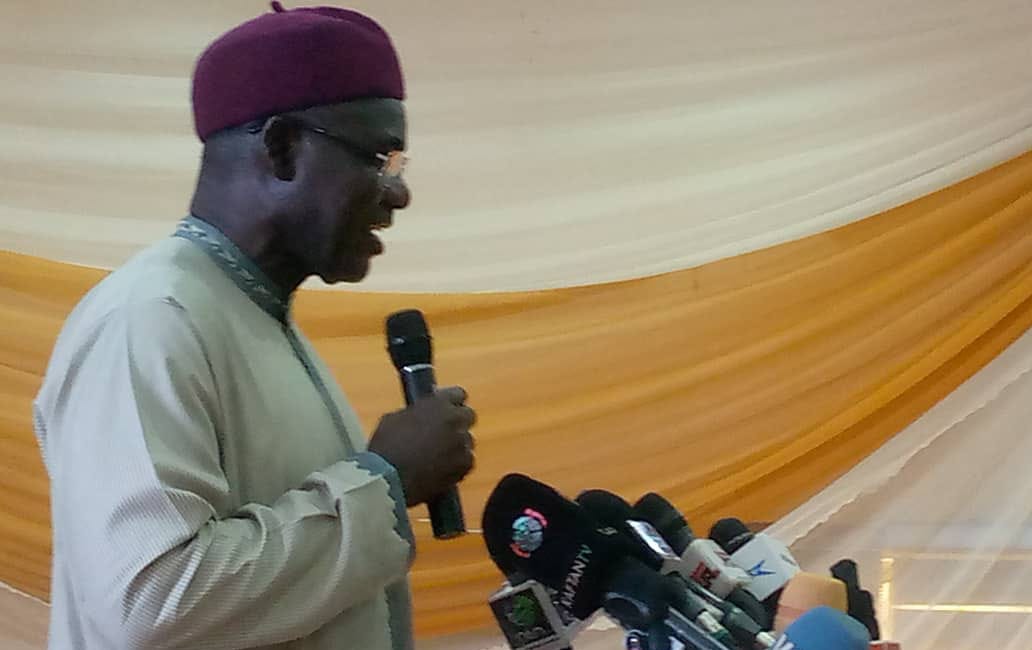
FORMER Chief of Army Staff, Lt Gen. Tukur Buratai (retd.), has said the $1bn approved for defence procurement during his tenure as Army Chief was released to the Ministry of Defence.
Speaking at the Defence Correspondents Association of Nigeria (DECAN) conference in Abuja on Monday, Buratai described the allegations surrounding the funds as “political and malicious”, saying they first emerged during the 2019 election period when the opposition alleged the money had been diverted for electoral purposes.
“The $1 billion was approved by the National Economic Council for defence procurement. Not a single dollar of that fund passed through my hands or through the accounts of the Nigerian Army, Navy, or Air Force.
“The funds were released to the Ministry of Defence, and the entire procurement process was handled by that ministry. The Army, Navy, and Air Force never had a single dollar from that fund to make procurement directives. I have described these allegations as political and malicious. They first surfaced during the 2019 election period, when the opposition alleged the funds had been diverted for electoral purposes — a claim the Federal Government publicly refuted. Yet the stain remained, attached to the Service Chiefs rather than the institution that managed the funds,” Buratai stated.
He, however, called for greater transparency in military procurement, recommending the establishment of a defence procurement transparency portal to publish information on contracts awarded, contracting entities and delivery timelines, subject to national security considerations.
“The Ministry of Defence must own procurement records. The $1 billion arms procurement controversy festered because the institution that managed the funds — the Ministry of Defence — remained silent while Service Chiefs absorbed criticism,” he said.
In his welcome address, the President of DECAN, Comrade Odita Sunday, said Nigeria’s national security can no longer be defined only by what happens on the traditional battlefield, calling for a shift to intelligence-led, technology-enabled operations.
He noted that terrorist organisations and criminal networks are increasingly exploiting technology for communication, recruitment and coordination.
Odita said modern technologies such as artificial intelligence, data analytics, satellite surveillance, unmanned systems and secure communications can significantly enhance the capabilities of security agencies, but technology alone is not enough.
“It must be supported by competent personnel, adequate training, effective institutions, inter-agency cooperation and sound policies,” he said.
He called for stronger intelligence sharing among security agencies.
“The threats confronting Nigeria do not operate within institutional boundaries. A single security challenge may require military, police, intelligence, cyber and financial responses. Our agencies must therefore work together and share relevant intelligence in a timely and secure manner,” he stated.
“As our economy and public institutions become increasingly digital, critical infrastructure and national databases must be protected from cyber threats. We must invest in cybersecurity expertise and encourage Nigerian professionals and technology companies to develop solutions that address our unique security challenges,” he said.
On recent losses in the Armed Forces, Odita said recent events have reminded Nigerians of the human cost of military service.
Speaking on the role of the media, Odita said defence correspondents have an important role in the evolving security environment.
“Our responsibility is not only to report events, but also to help Nigerians understand the changing nature of national security. We must report accurately, responsibly and professionally, while respecting legitimate operational sensitivities.
“In an age where misinformation can spread rapidly, accuracy must always come before speed. At the same time, national security should not be used to prevent legitimate journalism and accountability. There must be mutual respect between the media and security institutions,” he said.
He reaffirmed DECAN’s commitment to professional defence journalism and constructive engagement with security institutions.
“DECAN will continue to provide platforms for dialogue among the military, security agencies, policymakers, technology experts, academics and the media. We will also continue to encourage our members to deepen their understanding of emerging technologies, intelligence, cybersecurity and modern warfare.
“Most importantly, we will continue to recognise and celebrate individuals and institutions whose contributions to national security and professional journalism deserve commendation,” he added.
Odita stressed that Nigeria must prepare today for tomorrow’s security challenges.
“We must invest in intelligence, technology, cybersecurity, human capital, research, innovation and inter-agency cooperation. We must also ensure that the use of emerging technologies remains guided by law, ethics, accountability and respect for human dignity.
“The future of national security will depend not only on the weapons we possess, but on the quality of our information, intelligence, institutions and people,” he said.
In his conclusion, he said the conference provides an opportunity to exchange ideas and develop practical solutions to Nigeria’s evolving security challenges.
The Minister of Information and National Orientation, Mohammed Idris, said Nigeria’s security challenges cannot be addressed by military force alone, calling for improved intelligence, modern technology and stronger collaboration among security agencies and communities.
Idris, represented by the Director-General of the Voice of Nigeria, Jibrin Ndace, said military operations remained necessary but must be complemented by measures to address the conditions enabling criminal groups to recruit members and threaten the lives and livelihoods of citizens.
“This conference’s theme is particularly relevant because today’s security threats cannot be addressed by force alone. Military operations remain necessary, but they must be supported by reliable intelligence, modern technology, effective coordination among security agencies and cooperation with communities,” he said.
The minister said President Bola Tinubu’s Renewed Hope Agenda placed national security at the centre of Nigeria’s development, adding that the administration was pursuing the modernisation of the Armed Forces, intelligence-led operations, improved surveillance and stronger coordination among security and intelligence agencies.
He disclosed that Tinubu, in August 2026, directed the preparation of a comprehensive National Threat Assessment and a rolling five-year Strategic Defence Operations Plan to improve coordination, establish priorities and guide the deployment of resources.
“This is an important step towards a more coherent national response to evolving threats,” Idris said.
He also said the President had approved salary increases of between 30 and 80 per cent for Armed Forces personnel, effective September 2026, describing the decision as recognition of the sacrifices made by security personnel.
According to him, security initiatives must translate into tangible improvements in the lives of Nigerians, including safer communities and roads, protection for farmers and businesses, and an environment where children can attend school without fear.
On the role of the media, Idris said accurate reporting and responsible verification were necessary to help citizens understand security developments and prevent rumours from creating panic or undermining military operations.
Former President of the Senate and Chairman of the Senate Committee on Defence, Senator Ahmed Lawan, called for a dedicated percentage of Nigeria’s revenue to fund the Armed Forces of Nigeria and other security agencies to procure more platforms.
He said the National Assembly has been supporting the Armed Forces and other security agencies by way of budgetary approvals.
“For us in the National Assembly, it is our duty to support the arm of government, to ensure that whatever resources are available and are required, are requested by the arm of government, we support that and we even give more,” he said.
He reiterated that constitutionally, the security and welfare of citizens is the essence of government.
“Therefore, we will continue to support our work with the arm of government to ensure that the resources that we have within our constraints are made available for our security agencies and armed forces,” he said.
“Let me at this point suggest that as we receive more and more revenues, better revenues than before, especially outside of the war, I think we need to have more platforms, more weapons, purchase in bulk. Maybe we need to dedicate a certain percentage of our resources to arm our armed forces and other security agencies to safeguard this country.
“I believe that this is one way of ensuring that our armed forces are better supported because you cannot send someone to go out and fight with little and of course expect much success. But credit to our armed forces and other security agencies, we are still doing very well. But I believe that we need to give you a lot more. That’s why the National Assembly is thinking that budgets for the armed forces and other security agencies should be on first line charge because this will contain the problems that sometimes our armed forces face in terms of budget releases and other resources that must make them do better and so on,” he said.
He charged journalists to inform Nigerians about the services of security agencies despite pockets of insecurity in the country.
“I believe that our armed forces are still working so hard and therefore from time to time when we face banditry, it’s not a good reason for anyone to say Nigeria is totally insecure. It’s not true. I believe that we have moved from where we were to a better situation now but we can make this better, far more better. We will continue to fight the way we have been fighting insurgency and banditry and other criminal activities in the country,” he concluded.