
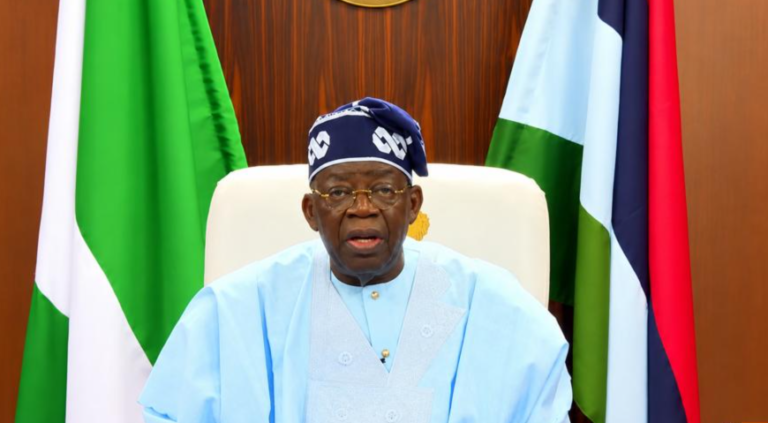
PRESIDENT Bola Tinubu has warned that Nigeria’s fight against corruption will yield limited results unless all three arms of government take collective responsibility for tackling graft.
He insisted that the judiciary must play a more active role in preventing influential individuals from exploiting legal loopholes to evade prosecution.
Mr Tinubu said corruption undermined public institutions across the executive, legislature and judiciary, making it a national challenge that could not be treated as the exclusive responsibility of the Federal Government’s executive arm.
The President spoke on Tuesday in Abuja at the eighth annual capacity-building workshop for judges and justices, organised by the Economic and Financial Crimes Commission (EFCC) in collaboration with the National Judicial Institute (NJI).
Represented by Vice President Kashim Shettima, Mr Tinubu described the fight against corruption as a battle for Nigeria’s collective survival, urging judicial officers to ensure that legal technicalities and procedural delays did not become instruments for protecting individuals accused of financial crimes.
He said the judiciary must examine prosecution strategies, review outdated precedents and close procedural gaps that politically exposed persons and organised criminal networks exploit to delay or frustrate trials.
“Probe prosecution strategies, dismantle outdated precedents, and seal procedural gaps that politically exposed persons and organised crime actors exploit to delay or frustrate trial,” the President said.
He argued that it was a fundamental error to frame the anti-corruption campaign as an executive agenda, noting that the consequences of corruption extended beyond government institutions to ordinary citizens whose access to public services and justice could be undermined by compromised systems.
Mr Tinubu maintained that every arm of government had a responsibility to protect public institutions and ensure that the law served the interests of society rather than individuals seeking to use their influence to escape accountability.
“We must no longer permit legal pyrotechnics and procedural pedantry to shelter criminality.
“The Bench is not merely a mechanical arbiter of rules, but an active guardian of moral order and social equity,” he said.
The President urged judges to approach their responsibilities with an understanding that the administration of justice involved more than the technical application of legal provisions.
“Law is, by design, an instrument of social engineering; it must invariably prioritise the public good over narrow, selfish interests shielded by technical manoeuvres.
“Our courts must embody the spirit, and not just the arid letter, of the law,” he added.
He said Nigeria could not make meaningful progress in uprooting corruption without an independent, progressive and reform-minded judiciary capable of responding to emerging criminal threats while safeguarding the integrity of the justice system.
Tinubu Tasks Bench on Digital Crimes
Mr Tinubu also called on the Bench to assess the adequacy of existing statutory frameworks in dealing with financial crimes that have become more sophisticated through the use of technology.
He identified blockchain technology and artificial intelligence as developments that had introduced new layers of complexity to traditional criminal activities, requiring law enforcement agencies and judicial authorities to continually strengthen their technical knowledge and professional capacity.
“My Lords, we confront a rapidly shifting criminal landscape. Technology has amplified the audacity and reach of illicit actors, ushering in sophisticated crimes driven by destructive ingenuity.
“The rise of blockchain technology and artificial intelligence has introduced unprecedented layers of complexity to traditional illicit activities,” he said.
The President described the theme of the workshop, “Investigation and Prosecution of Economic and Financial Crimes in a Digital Age,” as timely, stressing that criminal methods continued to evolve and that public institutions must not allow technological developments to outpace their capacity to investigate and prosecute offenders.
EFCC’s Record Under Spotlight
He commended the EFCC for its recent operations against cryptocurrency-related fraud, including the recovery of virtual assets linked to investment scams.
Mr Tinubu disclosed that in 2025, the commission secured the forfeiture of $22,417.91 in Bitcoin, 1,001,301.87 USDT in digital assets and $5.6m linked to the CBEX scheme.
He also said 192 foreign nationals arrested over alleged cyber-terrorism and cryptocurrency fraud had been prosecuted and deported.
The President further commended the commission for securing 10,872 convictions from 14,476 cases filed within the first 34 months of his administration, representing a conviction-to-filing ratio of 75.1 per cent.
He said the EFCC recorded 1,370 convictions from 1,889 cases filed in the first half of 2026.
Mr Tinubu added that the commission recovered N1.233tn, $684.48m, £373,905.78 and €9.34m in monetary assets during the period under review.
He described the commission’s efforts to tackle cryptocurrency fraud and recover virtual assets as reassuring, but insisted that the judiciary must complement law enforcement operations by rapidly improving its capacity to handle digital evidence and adjudicate increasingly complex financial crime cases.
Mr Tinubu acknowledged the reform efforts of the Chief Justice of Nigeria, Justice Kudirat Kekere-Ekun, and pledged the executive’s support for initiatives aimed at equipping the judiciary to deliver justice in the digital age.
CJN, Stakeholders Weigh In
Justice Kekere-Ekun said the workshop reflected the commitment of the NJI and the EFCC to addressing challenges in the justice system.
She noted that technological advances had changed how digital evidence was obtained and recorded, making disciplined case management essential to effective criminal justice in the digital era.
The CJN said sustained judicial education had contributed to improvements in the conduct of judicial officers, particularly in case management.
The Chairman of the Senate Committee on Anti-Corruption and Financial Crimes, Senator Emmanuel Udende, said the workshop was timely, given the increasing sophistication of financial crimes, particularly cases involving politically exposed persons that could affect the timely disposal of trials.
He assured stakeholders that the National Assembly would support the fight against corruption through proactive legislation.
The Attorney-General of the Federation and Minister of Justice, Lateef Fagbemi (SAN), represented by the Director of Public Prosecutions, Rotimi Oyedepo (SAN), said no single arm of government could tackle corruption alone.
He urged judges and lawyers to use the workshop to strengthen investigations and ensure more diligent prosecutions.
The Administrator of the NJI, Justice Babatunde Adejumo, described the EFCC-NJI collaboration as an important part of the government’s efforts to combat financial crimes, adding that the Vice President’s presence demonstrated the administration’s commitment to the anti-corruption campaign.
EFCC Chairman Ola Olukoyede described the workshop as a national imperative, saying the commission had adopted a reform-oriented approach and recorded significant convictions and recoveries under his leadership.
He assured participants that recovered money and property would be handled transparently and judiciously.