
Ebenezer Adurokiya, Reporting
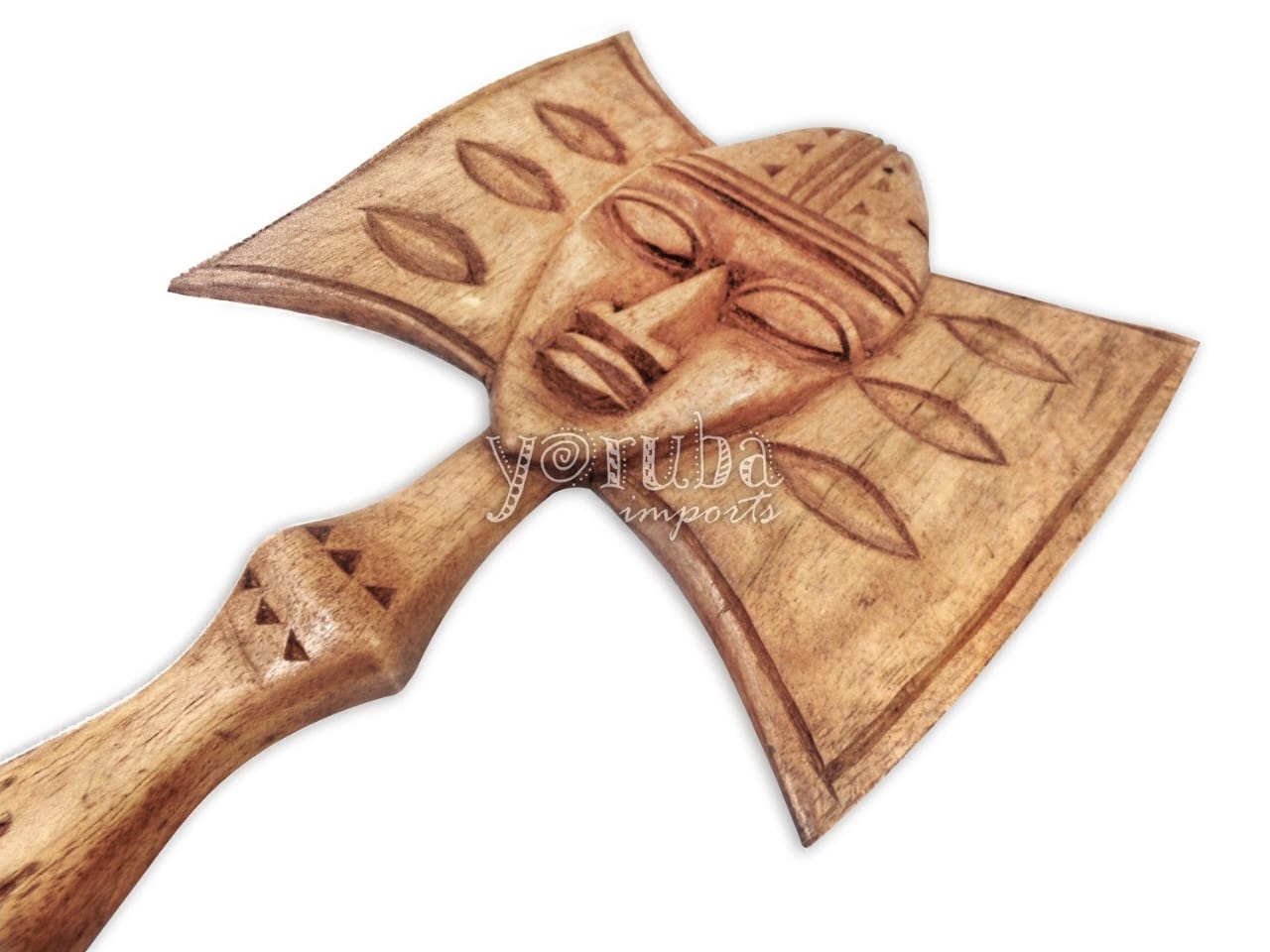
BRAZIL’S Supreme Federal Court (STF) has formally installed a sculpture of the Ọ̀ṣẹ́ Ṣàngó, the sacred double-headed axe of the Yoruba deity of justice, in a historic move that places an Afro-Brazilian religious symbol within the permanent collection of the nation’s highest judicial body for the first time.
The ceremony, held on 17 November at the court’s headquarters in Brasília, coincided with the National Week of Black Consciousness and took place just three days before Brazil’s Black Consciousness Day on 20 November . The artwork now stands in the hall of the Noble Hall on the second floor of the STF building, near the entrance to the plenary chamber.
The piece, titled “Osè Wura Otito” — translated from Yoruba as “Golden Axe of Truth” — was created by Bahian artist Rodrigo Siqueira. Standing 64 centimetres tall, the sculpture is crafted from angelim hardwood and adorned with copper and gold leaf, beads, coral and cowrie shells . It was donated to the court by the Institute for the Defence of the Rights of Afro-Brazilian Religions (Idafro), which lodged the formal request in February 2025.
In Yoruba tradition, Ṣàngó is revered as the orisha of thunder, lightning and justice, and the Ọ̀ṣẹ́ — a ritual axe with two symmetrical blades facing opposite directions — symbolises the responsibility to weigh all sides of a dispute before delivering judgment . The symbol has already been adopted in the courtrooms of Bahia, Rio de Janeiro and São Paulo, and its arrival at the STF extends a broader movement within Brazil’s judiciary to acknowledge African ancestral traditions.
The installation follows a unanimous ruling by the STF in November 2024, which held that the presence of religious symbols in public buildings is compatible with the secular nature of the Brazilian state and with religious freedom, provided they represent manifestations of the country’s cultural tradition . The court’s plenary hall already features a Catholic cross behind the president’s chair, a detail that has fuelled debate over the representation of diverse traditions in institutional spaces.
Speaking at the ceremony, STF President Minister Edson Fachin described the occasion as an act of institutional commitment. “I believe this court not only receives an object of immense symbolism, but welcomes, above all, a wisdom, a way of seeing and being in the world,” he said . He drew a parallel between the double-bladed axe and the traditional scales of justice: “An axe with a single blade would lean to one side. The double-bladed one belongs to neither party. That is a powerful message for the judiciary: it cuts with equal rigour on both sides”.
Ìyá Márcia de Ògún, a representative of the National Network of Afro-Brazilian Religions and Health (Renafro), used the platform to address the persistence of religious intolerance. “There is no true justice where there is racism; there is no full democracy where certain religious expressions are treated as inferior,” she said, arguing that secularism must mean “respect, plurality and equal treatment, not the invisibility of historically discriminated religions”.
The installation has been welcomed by cultural advocates in Nigeria, with the National Institute for Cultural Orientation (NICO) describing the adoption of the Ọ̀ṣẹ́ Ṣàngó in Brazilian judicial spaces as “a symbolic return of ancestral justice” and a source of pride for Yoruba culture . The institute noted that the symbol’s presence beside the scales of justice in Brazilian courtrooms affirms the enduring influence of Yoruba civilisation on the Americas.
For Idafro president Hédio Silva Júnior, the significance extends beyond symbolism. He described the installation as a concrete expression of constitutional pluralism and a recognition of the demands of traditional Afro-Brazilian communities, adding that it reinforces the court’s commitment to ensuring that judicial decisions do not reproduce racial ideologies or preferences.
The STF’s move is the latest in a series of institutional gestures acknowledging African heritage in Brazil, a country where more than 55 per cent of the population identifies as Black or mixed-race according to the 2022 census . As Fachin noted in his address, the recognition of African ancestry is not a separate chapter of Brazilian history but an integral part of it.