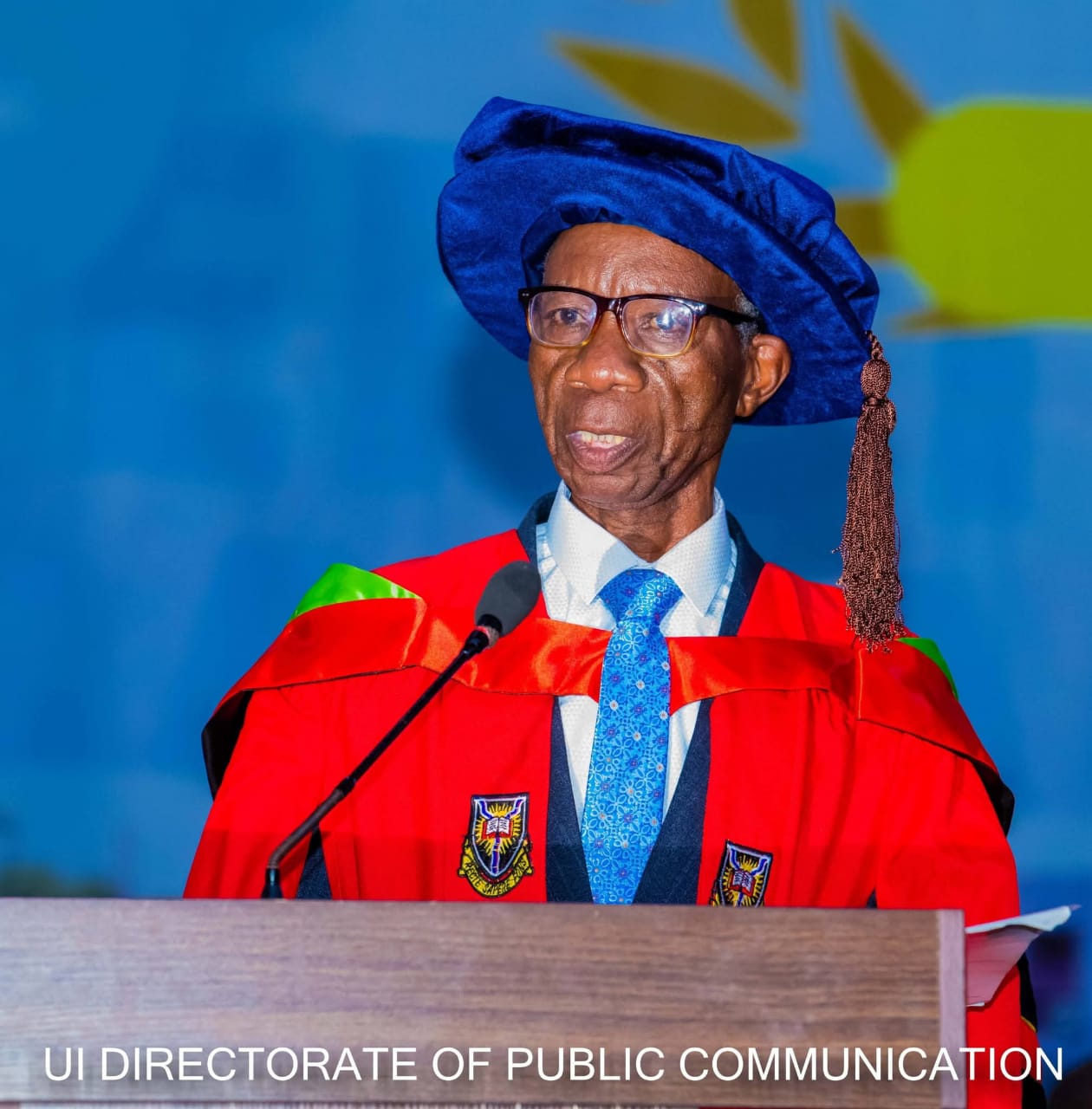
A Professor of Linguistic Stylistics and Applied English Linguistics at the University of Ibadan, Professor Opoola Ayotunde Ogunsiji, has called for greater attention to stylistic competence in the use of Nigerian English to promote effective communication across diverse social, academic and professional contexts.
He made this call while delivering the 624th Inaugural Lecture of the University of Ibadan on behalf of the Faculty of Arts.
The lecture was entitled, “Resolving Stylistic Indifferentiation in Nigerian English.”
Professor Ogunsiji explained that language is a socially acquired, symbolic and dynamic system through which individuals communicate ideas, express identity and participate in cultural life, noting that its effective use requires an understanding of the social contexts in which communication takes place.
The Lecturer stated that Nigerian English has evolved as a legitimate variety of English shaped by the country’s multilingual and multicultural environment, adding that English plays important roles in education, administration, commerce, mass media and inter-ethnic communication in Nigeria.
He explained that stylistic indifferentiation refers to the blurring of conventional boundaries between formal and informal, standard and non-standard, as well as spoken and written language.
According to him, such blending is increasingly evident in contemporary Nigerian communication and he highlighted multilingualism, educational practices and the rapid growth of digital communication as major factors contributing to stylistic indifferentiation in Nigerian English.
He noted that social media and other digital platforms have encouraged users to combine different linguistic forms and registers in ways that were not traditionally associated with particular contexts.
The Professor of Linguistic Stylistics stressed that grammatical correctness alone was not sufficient for effective communication, restating the difference between grammaticality and acceptability.
He explained that a grammatically well-formed expression might still be inappropriate in a particular social situation, restating that effective communication requires users to understand when, where and how different linguistic forms should be employed.
He further explained that stylistic choices could serve productive purposes when deliberately used to express identity, solidarity, humour and cultural affiliation. He, however, cautioned that inappropriate movement between styles could become counterproductive, particularly in formal academic, professional and institutional communication.
The Don cited instances in which informal expressions, slang, abbreviations and indigenous linguistic forms were introduced into formal communication, as well as situations where highly formal expressions were used in informal interaction, noting that these combinations demonstrated the increasing mobility of Nigerian English users across different stylistic registers.
Professor Ogunsiji also discussed the relationship between language, culture and thought, emphasizing the role of language as a major marker of identity and a vehicle through which cultural values and experiences are expressed.
He explained that stylistics, as a branch of applied linguistics, provides a useful framework for examining how language choices vary according to context.
The Inaugural Lecturer said that language users should be able to move appropriately along the continuum between formal and informal styles rather than treating one style as inherently superior to the other.
He stressed that effective communication depends largely on selecting a style that corresponds with the purpose, audience and setting of communication.
He, therefore, advocated the integration of listening, speaking, reading and writing skills in the teaching of English, reiterating the importance of communicative competence in preparing learners to use language appropriately in real-life situations.
The Don also recommended greater emphasis on contextual stylistic competence in language education and urged teachers to equip learners, not only with grammatical knowledge but also with the ability to recognize appropriate registers and adapt their language to different communicative situations.
He advised that Nigerian English should be studied and taught with an understanding of its postcolonial development, indigenous influences and evolving communicative functions, while maintaining appropriate standards for formal communication.
He further called for greater awareness among students, professionals, educators and other language users of the consequences of stylistic choices, particularly in an era where communication increasingly takes place across academic, institutional, social and digital platforms.
The Professor of Linguistic Stylistics and Applied English Linguistics submitted that resolving stylistic indifferentiation did not require suppressing the creativity, identity or cultural expressions embedded in Nigerian English.
He, rather, advocated a balanced approach that would enable users to recognise when stylistic blending was purposeful and when adherence to an appropriate register was necessary.
The lecture was the 21st in the series for the 2025/2026 academic session.
Courtesy: UI DIRECTORATE OF PUBLIC COMMUNICATION