By Lasisi Olagunju
JACOB Zuma was President of South Africa when he declared on October 21, 2013 that South Africa should not “think like Africans in Africa, generally.” The remark, delivered at an ANC manifesto forum at Wits University elicited gasps across Africa. History remembers it as the infamous “I am not an African” speech.
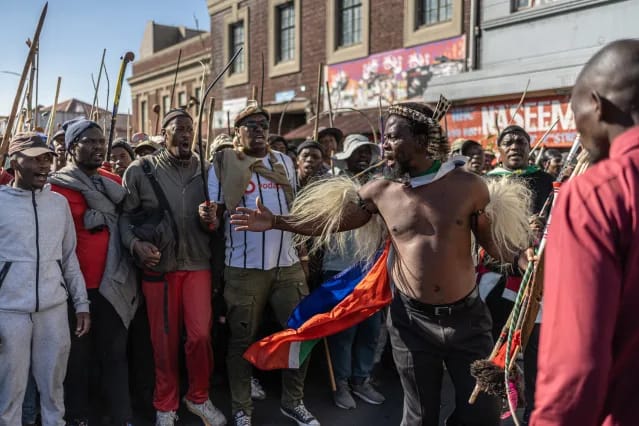
As of three days ago, the Nigerian government has evacuated 801 Nigerians from South Africa. From city to city, black South Africans were almost unanimous that their poverty was because of blacks from other African countries.
“Go home. Go back to your country.” They told everyone.
The English word ‘xenophobia’ has been around for almost 200 years. The Greek have ‘xenos’ (stranger) and ‘phobos’ (fear). Those are the parts with which the light-fingered English Language forged ‘xenophobia’, which now means “the fear, hatred, or deep distrust of people perceived as foreigners, outsiders, or culturally different.” But my teacher said I should not apply that word to South Africans and their current ‘Africa Must Go’ campaign. The fear and hatred they have for foreigners knows boundaries; the hatred is geo-colour sensitive. Only black Africans from outside South Africa are routinely marked out for rage. My teacher said the proper word for that hatred is Afrophobia.
Zuma’s 2013 statement reveals something deeper than a careless pronouncement. It betrays the ideology of South African exceptionalism – the belief that the country is more civilised, more entitled and somehow less ‘African’ than the rest of the continent.
With ‘exceptionalism’ is ‘Afrophobia’, South Africa’s peculiar disease. South Africa’s violent eunuchs will not stop blaming fellow Africans for their personal failures and frustrations. Exactly as Zuma said, they’ve always bought into their own hype of supremacy, and because of that, they think it makes good economic sense to view outsiders as inferior targets for hostility and their expulsion the elixir for their economic impotence.
Should Nigeria and Nigerians, in retaliation, ask South African companies to leave Nigeria? Should they not? These are uncomfortable questions. Yet, every fresh wave of Afrophobic attacks in South Africa makes it harder to avoid. A country whose companies earn billions of dollars annually from Nigerian consumers owes Nigerians more than condolences whenever they are hunted, assaulted and dispossessed on South African streets. It owes them protection.
At the beginning of the latest madness two months ago, Edo senator, Adams Oshiomhole, asked Nigeria to “take away the South African rights” from what those Afrophobes have in Nigeria. He mentioned the telecoms company, MTN. Adams was a lone voice crying in the wilderness. Other big people thought negotiation would soften the heart of the arrogant who think they are specially created.
If Nigeria does what Oshiomhole suggested, would it be doing what no one has ever done before? In fact, it would actually be doing justice to its historical relationship with South Africa.
Read Ann Genova’s ‘Nigeria’s Nationalization of British Petroleum’. In defence of suffering black South Africans, on 30 July 1979, the Managing Director of the Nigerian National Petroleum Company (NNPC), acting on behalf of Nigeria’s Head of State, General Olusegun Obasanjo, sent a telegram to BP (Nigeria) Ltd. informing the company that Nigeria had decided to “increase its participation to 100 per cent” in Shell-BP and BP (Nigeria). The reason was explicit: the United Kingdom was proposing to resume oil supplies to apartheid South Africa. To Nigeria, that decision was an unjust endorsement of the oppressors of black South Africans.
In Yorubaland, we say that if you make enemies because of a piece of firewood, that wood should at least give you enough warmth. Nigeria made costly enemies in defence of black South Africans. Today, the very people for whom Nigeria paid that price chase Nigerians through the streets of their country like rabbits. History rarely serves up an irony more painful than that.
So, let the lesson in Nigeria’s past engagements provide the pathway to the future of our relationship with South Africa.
In doing that, I suggest that Nigeria answers today’s hostility with the same economic instruments it deployed in defence of South Africans 47 years ago. There is a certain justice in irony. There would be a certain poetic justice in that. The lesson would be simple: yesterday’s sacrifice should not continue as a subsidy to today’s ingratitude.
What I am saying here is that Nigeria once used economic power to defend South Africans; it should use same economic power now to defend Nigerians from the hostility of black South Africans.
If, in their days of freezing cold, the fire of nationalisation warmed them, let it now char the ungrateful into remembering that every act of solidarity deserves remembrance, and every act of ingratitude has consequences.
In their hostility, they think they are special and it shows in their swag. Exceptionalism says, “We are better than you.” At its most arrogant, it also says, “Without us, you cannot survive.”
Years ago, Nigeria’s juju music maestro, Ebenezer Obey, answered that conceit in a song: “Without me, my friend will not eat; without me, my friend will not drink.” Then he rebuked the boaster: “stop saying so; only God Almighty sustains all.” Obey understood what some politicians forget. No nation is indispensable.
On June 7 this year, while appealing for calm, President Cyril Ramaphosa said that “many communities have expressed anger about the number of foreign nationals running spaza shops, trading stores and other informal outlets.” He said many South Africans believed that “foreign enterprises are squeezing out South Africans from operating in these markets in their own communities.” The South African President then stressed that “these concerns must not be dismissed.” Government, he said, has a duty to “support local enterprise” and ensure that South Africans “participate meaningfully in the economy.” Fair enough. But does the Nigerian government owe its own citizens any less?
If South Africa may ‘lawfully’ deploy policies that strengthen domestic enterprise, Nigeria should not hesitate to adopt equally ‘lawful’ measures that strengthen Nigerian businesses where South African firms dominate strategic sectors. Reciprocity is one of the oldest principles of statecraft.
If South Africa insists it is unlike the rest of Africa, should it not also surrender the privileges it enjoys precisely because it is African? Why do South African companies flourish across the continent, especially in Nigeria? Every Nigerian who buys MTN airtime, subscribes to DStv, renews a GOtv decoder or streams Showmax contributes to the profits of South African corporations, the dividends of South African shareholders and the tax revenues of the South African state.
Apartheid means “apartness.” There is a cruel irony in watching a people whose freedom was secured by the sacrifices, solidarity and hospitality of other African countries now deploy the logic of exclusion against fellow Africans.
But “two can play that game.” And they should. Publicly available data shows that Nigeria does not merely receive South African investment; it invests in South Africa every single day. Nigeria substantially finances South Africa.
Nigeria is MTN Group’s largest market by subscribers and one of the principal engines of its profitability. It is a South African company. Records show that in the 2025 financial year, MTN Nigeria generated more than ₦5.2 trillion in revenue, accounting for roughly one-quarter of the group’s total revenue. MTN Group reported service revenue of R218.5 billion for 2025, with Nigeria contributing about 27 percent of the figure. Those earnings enrich MTN’s shareholders, many of them South African pension funds and retail investors, and ultimately enlarge Pretoria’s tax base.
MultiChoice, another South African company, tells much the same story. Millions of Nigerian households have financed DStv, GOtv, SuperSport and Showmax for years. Those subscriptions sustain a company whose headquarters, shareholders and principal tax obligations remain rooted in South Africa. In its 2025 financial year, MultiChoice contributed billions of rand in taxes, with a substantial share going directly to the South African government.
I told a friend that there should be consequences for what happened in South Africa last week. The friend told me that the consequences “will not be mob retaliation but statecraft.”
I nodded in agreement. It is for the government to do.
Diplomacy history is replete with cases of states using economic instruments to pursue foreign-policy objectives. The United States has, for instance, repeatedly done so through tariffs, sanctions and investment restrictions under presidents of both political parties. As law professors Ashley Deeks and Andrew Hayashi observe in ‘Tax Law as Foreign Policy’, Democratic and Republican administrations alike have shown “the same growing appetite for using economic tools to pursue foreign policy and national security goals.” Nigeria would not be inventing a new warhead if it fires this missile at South Africa.
My argument is about the responsibility of governments. If Pretoria repeatedly fails to protect Nigerians while South African companies continue to earn enormous profits from Nigeria, Abuja is entitled to review the terms of that economic relationship. Tax policy, competition law, procurement rules and investment regulations are legitimate instruments of foreign policy. States use them every day.
The old folktale warned us about the crow “beautified with our feathers.” Those who now peck at our eyes would do well to remember whose feathers first enabled them to fly. Oore pẹ́, aṣiwèrè gbàgbé. The foolish dismiss old favours because they were received long ago.
Enough of the insults. South African companies operating in Nigeria must be made to feel the heat of the fire raging against Nigerians in South Africa. South Africa cannot, through its businesses, continue to feast on Nigeria’s vast market while Nigerians are hunted in South African streets. As the Yoruba warn, if you let an ant climb you unchecked, it will keep climbing until it reaches even the forbidden place. Tell the Government of Nigeria that the Golden Rule has its counterpart in international relations: reciprocity. Or, in everyday language: do me, I do you.
Friendship demands reciprocity. So does commerce. Apply pressure where it matters. Their businesses are their pressure points; they are their balls. Hold those firmly enough, and the message will be heard.