Ebenezer Adurokiya and Micheal Chukwuebuka Reporting From Osogbo
A European Union-backed election observation coalition has reported 323 cases of electoral offences and irregularities across 726 polling units in Saturday’s Osun State governorship election, alongside 38 security incidents recorded by midday.
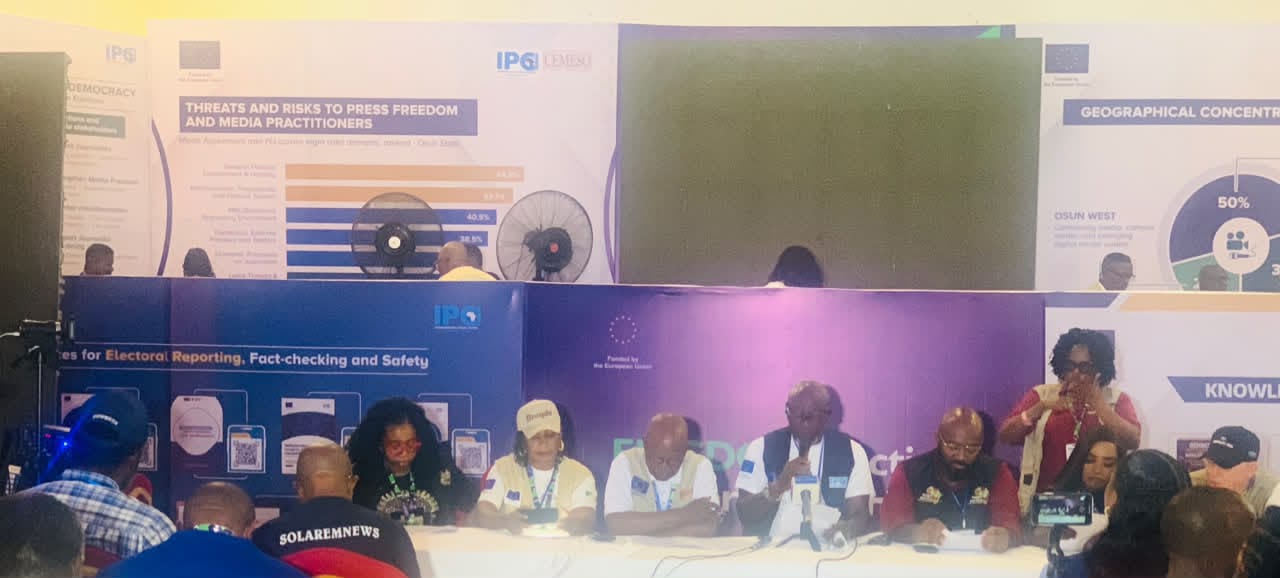
The EU Support to Democratic Governance in Nigeria Election Observation Hub (EU-SDGN EOH), comprising the Centre for Media and Society (CEMESO), International Press Centre (IPC), Nigerian Women Trust Fund (NWTF), TAF Africa, The Kukah Centre (TKC), and Yiaga Africa, deployed 823 accredited observers across all 30 local government areas to monitor the electoral process.
Presenting the preliminary findings in Osogbo, IPC Executive Director Lanre Arogundade disclosed that vote trading topped the list of infractions with 103 reported cases, followed by 85 instances of exposed ballot papers and 38 cases of campaigning at polling units.
Other irregularities recorded included 31 cases of voter obstruction, 28 instances of inducement involving polling and security officials, 14 cases of voter impersonation, 12 incidents of multiple voting, and seven cases of misconduct by election officials . The Hub clarified that the figures do not correspond to individual polling units, as multiple offences were recorded at some locations.
On the security front, observers reported 25 cases of thuggery, 12 attacks on electoral officials, and nine instances of voter intimidation involving security personnel . Specific incidents were flagged at polling units in Ejigbo and the Okanla area of Osogbo, where security agents were reportedly involved in intimidating voters.
Despite these challenges, the Hub described voter turnout as “impressive,” with women accounting for approximately 59 per cent of turnout in observed polling units and more than 70 per cent of persons with disabilities voting in the 12 designated accessible polling units monitored . Women constituted 36 per cent of polling officials deployed.
Technical difficulties also emerged, with 58 Bimodal Voter Accreditation System (BVAS) devices malfunctioning across observed polling units. However, 41 of these were successfully rectified, allowing accreditation to resume.
The Hub’s fact-checkers verified 11 false claims circulating during the election, including allegations of payments to INEC officials, police arrests, and underage voting . Claims relating to shooting incidents and disruption of voting remain under investigation.
Mr Arogundade noted that while most security personnel conducted themselves professionally, the Hub urged authorities to address reported cases of voter intimidation.
The coalition called on the Independent National Electoral Commission to deploy Rapid Response Technical teams and backup BVAS devices to polling units experiencing technical challenges.
Political parties and candidates were urged to pursue any grievances through lawful and judicial channels in accordance with the Peace Accord signed on 30 July.
The Hub also advised the media against reporting unofficial results before INEC’s formal declaration, urging journalists to intensify fact-checking to combat misinformation.
The Hub confirmed that the election environment remained generally conducive for journalists and observers, with no major incidents reported relating to impeded access to polling units.
A comprehensive post-election report will be released following the collation and declaration of final results.