
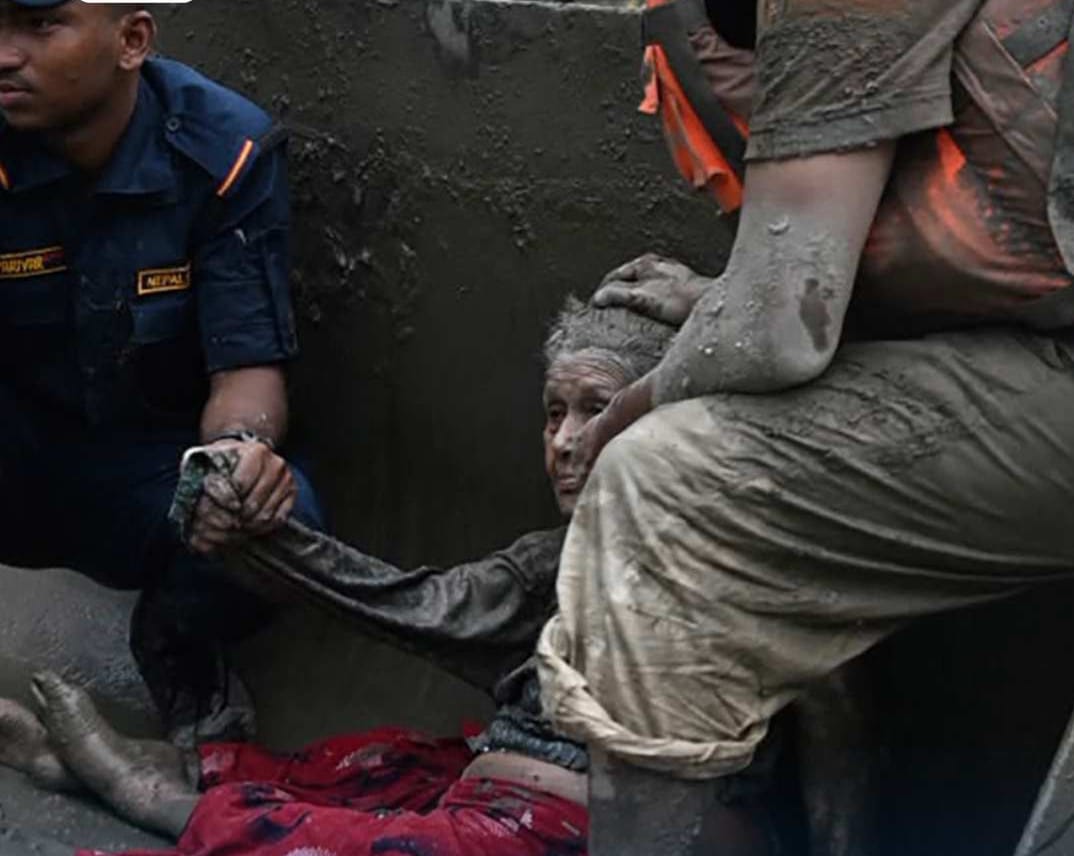
NO fewer than 160 people have been killed and 403 others reported missing after devastating floods and landslides struck areas along the Nepal-China border, leaving communities submerged and infrastructure severely damaged.
The disaster occurred on Wednesday in Nepal’s northern Rasuwa district, near the border with China, where torrents of water, mud and debris swept through settlements, destroying buildings and cutting off roads.
Nepali police said 157 bodies had been recovered, while Chinese state media reported three deaths and 265 people missing on the Chinese side of the border.
The disaster has also left hundreds of tourists unaccounted for. Nepal’s Tourism Ministry said 403 tourists were reported missing several hours after the flooding, including 341 foreign nationals.
Among the missing foreigners are 142 Indians, alongside nationals of Australia, Britain, Malaysia, the Netherlands, Portugal, South Africa, South Korea and the United States.
Villages Wiped Out
The International Federation of Red Cross and Red Crescent Societies (IFRC) described the destruction as extensive, with its Nepal head, David Fisher, saying entire villages and market areas had been “wiped out”.
The organisation said it was sending emergency supplies, including blankets, first-aid kits, stretchers and body bags, to support relief operations.
Surveillance footage reportedly showed people running for safety as a huge wall of debris swept across the Chinese side of the border, carrying away vehicles.
Nepali police photographs also showed floodwaters carrying buildings away, while some structures were left partially buried beneath thick layers of mud.
Rescue workers have been searching through mud and sludge for survivors as floodwaters and debris buried lower floors of buildings.
Rescue Operations Intensify
The Nepal Army has deployed helicopters to affected areas and rescued scores of people, while residents living near rivers in high-risk areas have been ordered to relocate to safer locations.
Prime Minister Balendra Shah pledged a comprehensive government response, assuring victims that the state would deploy its available resources to support those affected.
“The pain and loss you have suffered is not small,” Shah said in a statement.
“But I want to assure you that you are not alone in this difficult time — the state is with you with all its means and resources.”
Residents have also described the scale of the devastation.
Raju Bhadel, 56, said his brother-in-law called him in tears after the family home was swept away.
Three family members were rescued, he said, but another relative remained missing.
Cause Of Disaster Under Investigation
Authorities are still investigating the precise cause of the flooding, although preliminary assessments indicate that a landslide may have blocked a river and triggered a massive surge downstream.
Nepal’s Foreign Minister Shishir Khanal said an earthquake could have triggered a landslide, which subsequently blocked a river and caused water to rush downstream.
The country’s disaster management authority said satellite data suggested that a “snow-rock landslide” on the Nepal-China border may have caused the flooding.
Sarthak Shrestha, a remote sensing and geo-information analyst at the Kathmandu-based International Centre for Integrated Mountain Development, said a preliminary assessment indicated that a rock-and-ice avalanche had occurred on the Nepali side, blocking the Lhende River.
He warned that the blockage could have contributed to the cascading flood event.
China Orders Emergency Response
The flooding also caused significant damage to Gyirong Port, an important border trading hub in Tibet.
Chinese state broadcaster CCTV reported that a mudslide originating on the Nepali side had caused major casualties and left people missing at the port.
Chinese President Xi Jinping ordered an extensive rescue operation, directing authorities to prioritise the search for missing people, treatment of the injured and efforts to minimise casualties.
Traffic authorities in Tibet’s Shigatse also warned that roads in the region were unsafe because of the risk of further mudslides.
Authorities are additionally concerned that continued blockage of the river could trigger another major flood.
Qianggong Zhang, head of climate and environmental risks at ICIMOD, warned that another flood could occur if the upstream blockage remains.
Power Infrastructure Damaged
The disaster has also disrupted electricity supplies in Nepal, with the Nepal Electricity Authority reporting damage to about 430 megawatts of generation capacity, including hydropower and solar facilities.
Production, transmission and distribution infrastructure have all been affected, further complicating relief efforts.
Monsoon rains between June and September regularly cause deadly floods and landslides across South Asia. Scientists have also warned that climate change is contributing to more frequent and intense extreme-weather events.
Rescue teams are continuing to search for survivors and missing people as authorities on both sides of the Nepal-China border assess the full extent of the destruction.