
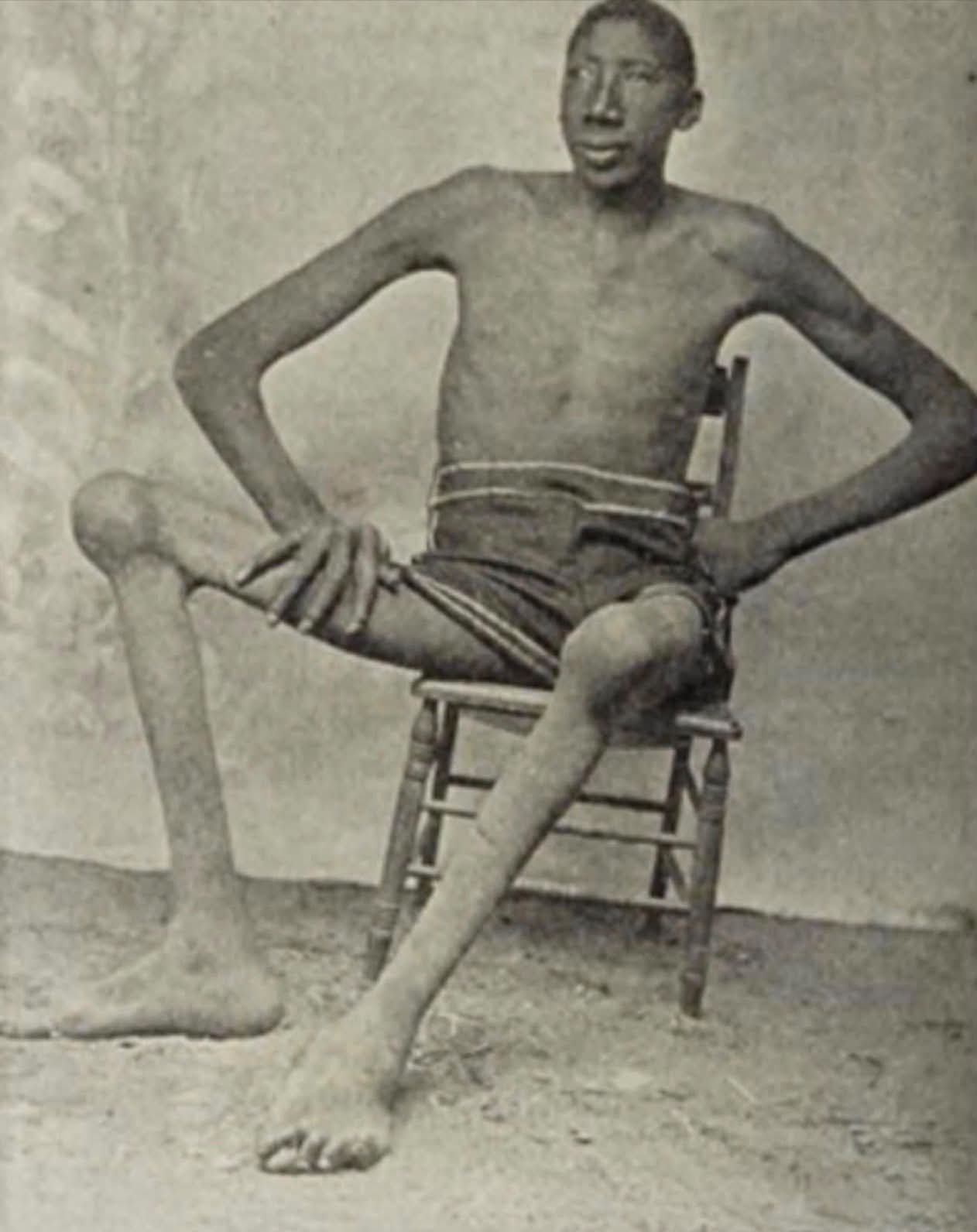
THEY feared what might happen to his body even after his death. So much so that his family is believed to have buried him in a concrete tomb to protect his remains from grave robbers and curious anatomists.
This is the story of John William “Bud” Rogan, the extraordinary American remembered as the tallest person of African descent ever recorded and the second-tallest person in documented history.
John William Rogan was born in Tennessee, United States, in the late 1860s. Sources differ on his exact birth year, with 1867 and 1868 commonly cited. He was the son of William Rogan, a formerly enslaved man, and one of 12 children.
Rogan was born into a society still grappling with the legacy of slavery and racial discrimination. No one could have imagined that the quiet boy would eventually become a figure whose extraordinary stature attracted widespread attention from the public and the medical community.
At about the age of 13, Rogan began growing at an extraordinary rate. His condition, described in historical medical accounts as gigantism, caused his height to increase dramatically. He subsequently developed ankylosis, a condition involving the abnormal stiffening or fusion of joints, which progressively restricted his movement.
By his mid-teens, Rogan could no longer stand or walk independently. As his condition worsened, he became unable to undertake conventional physical labour, making it increasingly difficult for him to earn a living.
A giant who refused the sideshow life
Rogan’s extraordinary height made him a subject of public fascination. During an era when people with unusual physical characteristics were frequently exhibited in circuses, carnivals and travelling shows, he reportedly rejected offers to join such attractions.
Rather than turn himself into an entertainment spectacle, he sought other ways to survive.
Unable to walk, Rogan constructed a cart from his bed and used goats to pull it. He became a familiar figure around Gallatin, Tennessee, where he travelled to the railway station to meet incoming trains and transport passengers’ luggage and packages to nearby hotels.
His work offered him a measure of independence despite the limitations imposed by his condition.
Although accounts circulated for years claiming that Rogan earned a living by selling his drawings and postcards, historical research has challenged the story that he was a successful artist. According to Guinness World Records, the claim appears to have resulted from confusion between Rogan and Sumner Fauley, a travelling cartoonist who produced and sold illustrations of him.
Rogan’s own story is remarkable enough without embellishment. His goat-drawn cart, determination to earn a living and reported refusal to join travelling shows reveal a man who sought to maintain some control over his life despite his physical limitations and the public curiosity surrounding him.
How tall was Bud Rogan?
Rogan’s height remains one of the most extraordinary aspects of his story.
He was measured at approximately eight feet six inches (259 centimetres) during his lifetime. By the time of his death, his height was estimated to have reached eight feet nine inches (267 centimetres).
However, the final figure was not established through a conventional standing measurement. Because Rogan could no longer stand upright, his height had to be calculated from measurements taken while he was seated. Consequently, his precise standing height cannot be confirmed with complete certainty.
Nevertheless, Guinness World Records recognises him as the tallest person of African descent ever recorded and the second-tallest person in documented history, behind Robert Wadlow, who reached eight feet 11.1 inches (272 centimetres).
Rogan’s extraordinary growth came at a considerable physical cost. By the end of his life, he reportedly weighed only 175 pounds (approximately 79 kilogrammes), reflecting the frailty associated with his prolonged condition.
His case attracted the attention of medical practitioners, including Dr William Lackey, who examined him and documented his condition. Rogan became an important subject in the historical study of extreme human growth.
The mystery surrounding his burial
John William Rogan died in September 1905 in Tennessee, aged approximately 37, according to commonly cited biographical accounts.
His death raised another concern: what would happen to his remains?
At the time, medical practitioners and anatomists sometimes sought access to human remains for research, while grave robbing and the unauthorised removal of bodies were recognised problems. Black people were particularly vulnerable to exploitation in medical and scientific institutions during this period.
Against this historical background, accounts of Rogan’s burial have suggested that his family took extraordinary measures to protect his body.
He is believed to have been buried in a concrete tomb, reportedly intended to deter anyone attempting to exhume his remains for examination.
The story has endured for more than a century. However, the precise details of the burial have not been conclusively established, and his final resting place remains unknown.
The account of the concrete tomb therefore occupies an intriguing place between documented history and longstanding local tradition. While the protective purpose attributed to the burial is widely repeated, it should not be presented as an independently confirmed fact.
A legacy beyond extraordinary height
Bud Rogan’s story is about more than the physical distinction that made him famous. It is also about disability, independence and the challenge of living in a society that often regarded people with unusual physical characteristics as objects of curiosity.
His life illustrates the difficulties faced by a man whose condition restricted his mobility and earning capacity, yet who found a way to work and move around his community.
His reported refusal to join travelling shows also forms an important part of his legacy. Rather than allow his extraordinary height to define every aspect of his existence, he sought to retain some control over how he lived.
The story of his burial adds another dimension to that legacy. Whether every detail of the concrete tomb account can be verified or not, it reflects enduring concerns about bodily dignity, the protection of human remains and the ethics of scientific curiosity.
Bud Rogan was not merely a medical curiosity. He was a human being whose life unfolded under extraordinary circumstances.
He could no longer stand, yet his story continues to stand out in history.
And more than a century after his death, the mystery surrounding his final resting place continues to draw attention to the life of the man remembered as the tallest person of African descent ever recorded.