Ebenezer Adurokiya, Reporting
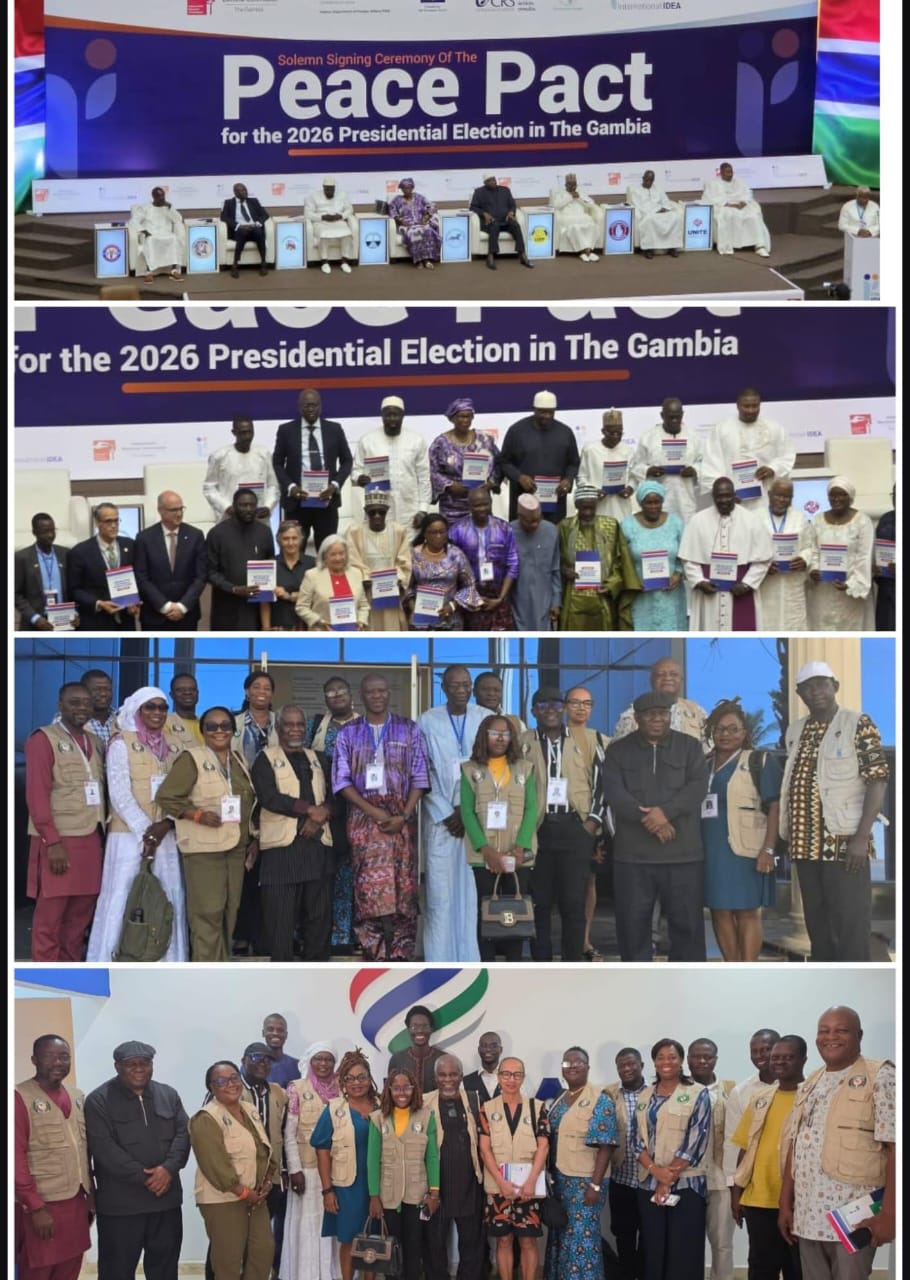
THE Gambia’s Independent Electoral Commission (IEC) has reaffirmed its readiness to conduct a credible and transparent presidential election scheduled for 5 December 2026, as eight approved candidates, including incumbent President Adama Barrow, have signed a Peace Pact committing themselves to a peaceful electoral process.
The IEC chairman, Joseph Kolley, gave the assurance on Monday, 16 November, during a meeting with the visiting Economic Community of West African States (ECOWAS) Long-term Election Observation Mission in Banjul.
Kolley disclosed that almost all electoral materials had been dispatched to the regions, while preparations were ongoing to train polling agents who would oversee voting at 1,773 polling stations across 730 polling centres.
On security arrangements, he said the Commission was working closely with security agencies to protect electoral officials, voters and the integrity of the election.
He added that a police commissioner had been assigned to the IEC to coordinate security-related matters.
Addressing concerns raised by civil society organisations over alleged underage voter registration, Kolley maintained that the Commission was strictly complying with the provisions of the law, particularly the Electoral Act, which stipulates the requirements for voter registration.
The IEC chairman disclosed that 1,146,474 voters had been registered for the forthcoming presidential election.
Meanwhile, the eight presidential candidates signed the Peace Pact in Banjul on Monday, pledging to conduct peaceful and issue-based campaigns, shun hate speech, avoid violence and intimidation, and respect the results declared by the electoral commission.
They also committed to resolving electoral disputes through lawful and peaceful means.
Among the signatories are President Barrow, who is seeking another term after his election in 2016, veteran opposition leader Oussainu Darboe, Talib Ahmed Bensouda and former Vice-President Dr Isatou Touray, the country’s first female presidential candidate.
Three of the candidates are contesting as independents.
The IEC also confirmed that a ninth contender, Ansu Sanneh, had voluntarily withdrawn from the race and endorsed Bensouda’s candidacy.
Speaking on behalf of the President of the ECOWAS Commission, the ECOWAS Permanent Representative and Head of Mission in The Gambia, Madam Naminata Meita Sangare, described the country’s democratic process as significant to the stability of the West African region.
She said The Gambia’s democratic journey was an important part of the region’s democratic landscape, stressing that its stability and peaceful development were matters of shared regional interest.
Each presidential candidate was given five minutes to address the gathering after signing the pact. Goodwill messages were also delivered by the National Elections Response Group, the African Union and the United Nations Office for West Africa and the Sahel (UNOWAS).
Former ECOWAS Commission President and UN Secretary-General’s Special Representative for West Africa and the Sahel, Dr Mohamed Ibn Chambas, who signed the agreement as an eminent person, cautioned the candidates that the pact must be backed by genuine commitment.
He said the agreement did not replace existing laws or enforce itself, adding that its effectiveness depended on the candidates’ commitment and the vigilance of Gambians.
Chambas further disclosed that a Monitoring Committee, working with moral guarantors, would closely monitor compliance and speak publicly where necessary.
Other witnesses and guarantors included IEC Chairman Kolley; the Chairperson of the Gambia Christian Council, Most Rev. Bishop Bannie Manga; President of the Gambia Supreme Islamic Council, Imam Alhaji Essa Darboe; Senior Representative of Civil Society, Fatou Jagne Senghore; and Jainaba Faye of International IDEA, The Gambia.
In a related development, the ECOWAS observers continued their consultations with stakeholders, meeting officials of the civil society organisation, Gambia Participate, led by its Executive Director, Marr Nyang.
The group commended the IEC for what it described as a transparent nomination exercise, noting that the process had helped restore public confidence following initial concerns.
However, the organisation called for improved political representation of women and the repeal of the Public Order Act, which it said undermined human rights and freedom of assembly.
The ECOWAS Observation Mission’s engagements form part of efforts to assess preparations for the December 5 presidential election and encourage a peaceful, credible and transparent democratic process in The Gambia.