Muhammed Abubakar, Reporting
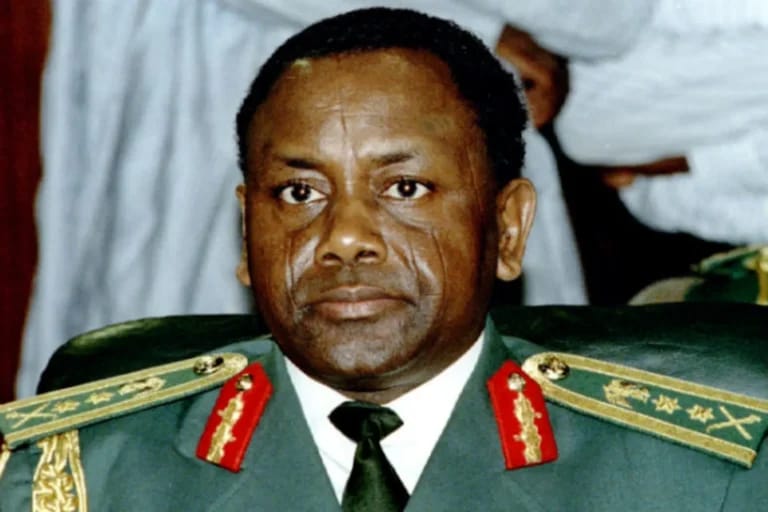
THE long-standing mystery surrounding the death of Nigeria’s former military ruler, General Sani Abacha, has finally been laid to rest, according to explosive new revelations from a retired security official.
The former dictator, who ruled Nigeria with an iron fist from 1993 until his sudden demise in 1998, died of a coitus-induced cardiac arrest while in the company of a young female pharmacist, the book claims.
Dennis Amachree, a retired Assistant Director of the Department of State Services (DSS), has disclosed the circumstances in his newly released 348-page memoir, ‘DSS @40: My journey behind the shield’.
“I did not kill him, he died on top of me,” the pharmacist reportedly confessed during interrogation, according to Amachree’s account.
The Final Hours
The book provides a minute-by-minute reconstruction of Abacha’s final moments at the Aso Rock Guest House in Abuja on June 8, 1998.
According to Amachree, at approximately 2.40am, shortly after the departure of General Jeremiah Useni, Abacha’s girlfriend arrived at the guesthouse from the Nicon Nogs Hilton Hotel, accompanied by her younger sister – a pharmacist who was in Abuja for a conference.
The Head of State, who had just purchased a new SUV for his girlfriend, was reportedly taken with the younger woman. After a brief social call, the girlfriend returned to the hotel, leaving her sister alone with the dictator.
At around 4.05am, as the pair became intimate, the pharmacist realised Abacha had stopped moving. She called out to him but found him unresponsive and stiff. In a state of panic, she quickly dressed and left, telling the soldier on guard duty that “Oga” had requested a car to take her back to her hotel.
The unsuspecting soldier promptly arranged transportation, and the pharmacist returned to the Hilton, where she informed her sister of what had happened. She was quickly driven to Abuja Airport to catch the 7am Okada Airline flight to Lagos.
The Interrogation
The retired security chief revealed that he personally interrogated the pharmacist at the Lagos State SSS Command in Ogudu.
“When I interrogated her myself, the first thing she said to me was: ‘I did not kill him, he died on top of me,'” Amachree writes.
The author claims this account puts an end to decades of conspiracy theories and speculation that have surrounded Abacha’s death.
“Any other narrative is an act of deceit and a disservice to our countrymen and women,” he stressed.
A Legacy Of Misinformation
Amachree’s book systematically dismantles six alternative narratives that have circulated over the years, including claims of poisoning by disaffected soldiers, the involvement of foreign intelligence agencies, and the infamous “poisoned handshake” theory propagated by Abacha’s Chief Security Officer, Major Hamzat Al-Mustapha.
The author criticised the deliberate propagation of false narratives by those close to the former ruler.
“The confusion surrounding Abacha’s death is a microcosm of a larger problem in Nigeria: a leadership culture steeped in falsehood and a lack of accountability,” he writes.
“While the truth may be suppressed temporarily, the forces of human curiosity and investigative inquiry will ultimately bring it to light.”
The Dictator’s Final Days
Abacha, who died at the age of 54, had ruled Nigeria for five-and-a-half years characterised by “extreme authoritarianism and brutal repression”, according to Amachree.
His regime was widely condemned for widespread human rights abuses, including arbitrary arrests, torture, and extrajudicial killings.
“The number of political detainees during his tenure reportedly exceeded the total from the entire British colonial period,” the book claims.
In the days before his death, Abacha had received emissaries from Palestinian leader Yasser Arafat and Pope John Paul II – the pontiff being his final visitor – who had come to Nigeria to plead for the release of political detainees.
The Wider Picture
At the time of his death, Abacha had been perfecting plans to transform himself from military dictator to civilian president. He had formed five political parties and installed loyalists to lead them, with all parties adopting him as their presidential candidate.
The late Chief Bola Ige, a former governor of Oyo State, famously described the five parties as “five fingers of a leprous hand”.
Abacha died barely a month before the death of Chief Moshood Abiola, the presumed winner of the annulled June 12, 1993 presidential election, who had been held in Abacha’s custody.
Amachree’s account reveals that the pharmacist was promptly located and flown back to Abuja following her interrogation. Her identity has been withheld.
The book serves as a poignant reminder, the author says, “that power is transient and that no amount of security can shield a leader from their ultimate fate.”