Ebenezer Adurokiya, Reporting
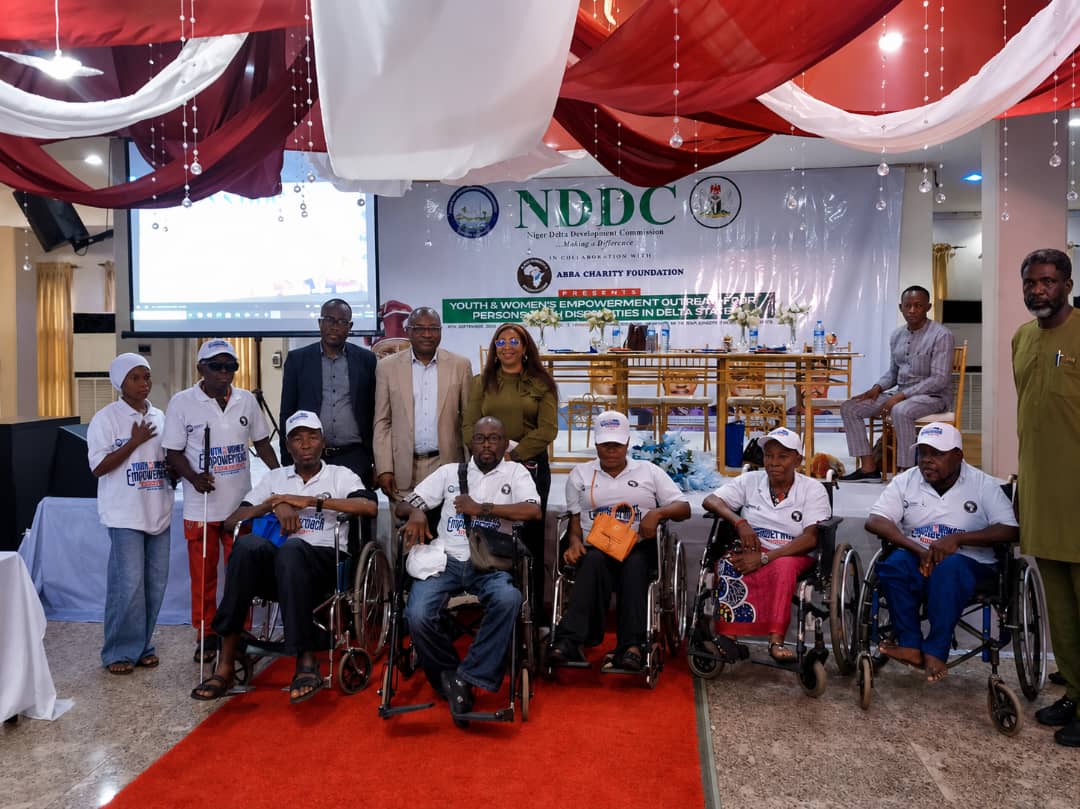
THE Niger Delta Development Commission (NDDC), in collaboration with the Abba Charity Foundation, has empowered more than 100 youths and women living with disabilities in Delta State, reaffirming its commitment to greater inclusion in its development programmes.
The empowerment programme, held in Asaba, brought together beneficiaries drawn from the three senatorial districts of the state as part of the NDDC’s broader intervention for women, youths and vulnerable groups across the Niger Delta.
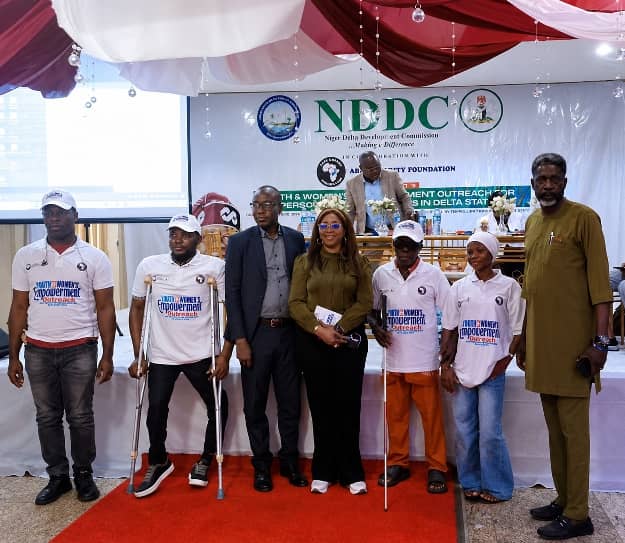
Speaking at the programme, the Director of Youth, Sports, Culture and Women Affairs at the NDDC, Mrs Ahunna Imoni, said the Commission was deliberately moving away from a charity-based approach to disability support towards inclusion and sustainable empowerment.
Imoni said the initiative was intended to demonstrate that persons living with disabilities were important stakeholders whose voices and contributions mattered in the development of the region.
She stressed that “disability is not inability”, adding that the NDDC would not support a development model that excluded any group.
“What the Board Chairman and the MD/CEO of NDDC are saying by this programme is that disability is not an inability. We are saying that we are moving from charity and pity to inclusion.
“We don’t want to run a region where people are excluded, any group. So we are including them in all that we are doing,” she said.
According to her, the beneficiaries were drawn from the Joint Association of Persons with Disabilities and other disability groups, including lawyers living with disabilities.
She explained that the intervention was only the beginning, noting that persons with disabilities would be given consideration in subsequent training and empowerment programmes organised by the Commission.
Imoni also disclosed that the NDDC had employed some persons living with disabilities, including blind and physically challenged persons, as part of its commitment to promoting inclusion.
The Project Coordinator of the Abba Charity Foundation, Rukayat Olowodola, said the programme was designed to promote inclusion, resilience, self-reliance and economic independence among persons living with disabilities.
Olowodola expressed appreciation to the NDDC Board and management for supporting the initiative, stressing that development could only be meaningful when no individual or community was left behind.
The programme featured sessions on understanding disability and inclusion; skills for self-reliance and economic empowerment; and advocacy, leadership and community participation.
The first session, facilitated by the Chairperson of the NBA Lawyers with Disabilities Forum, Asaba, Patience Nkeonyeasua Etumadon, focused on the rights of persons with disabilities, inclusion and the significance of the International Day of Persons with Disabilities.
The second session, handled by a Chief Lecturer and Director of Consultancy Services at the Federal College of Education (Technical), Asaba, Dr Isioma S. Edozie, focused on vocational skills, entrepreneurship, financial literacy and income-generating opportunities.
The third session, facilitated by Dr Felicia O. Momah, Senior Lecturer and Director of Academic Planning at the University of Delta, Agbor, centred on advocacy, leadership and community participation.
In separate interviews, Etumadon and Edozie said empowering a person living with a disability could have a multiplier effect, as such individuals could support their families and contribute to the development of their communities.
They called for sustained interventions that would go beyond one-off financial assistance to include education, vocational training, employment and access to opportunities.
The beneficiaries expressed appreciation to the NDDC for the outreach, saying the initiative had restored their hope.
One of the beneficiaries, Mrs Jennifer Anyanwu, said the intervention had “put smiles on their faces” and reaffirmed that living with a disability had not diminished their ability to be productive, self-reliant and make meaningful contributions to society.