By Ebenezer Adurokiya and Micheal Chukwuebuka
BEFORE we departed Ibadan, various rumours about happenings in Osun State circulating on social media had created considerable anxiety. It was noon on Thursday, August 13, when we set out for Osogbo. The team comprised the Publisher and Editor-in-Chief of Stonix News, Crimes Chroniclers and Naijaspora News, Ebenezer Adurokiya, and Reporter, Micheal Chukwuebuka.
The journey from Ibadan to Osogbo was far from smooth, given the bumpy and curvy nature of the road amid ongoing reconstruction from Iwo Road towards Ikire. From Gbongan, the road became smoother and wider, with a dual carriageway that terminated less than 10 minutes later. From that point until we entered Osogbo, however, the federal road was largely in poor condition.
We arrived in Osogbo amid a heavy presence of soldiers and other security personnel manning strategic locations. We headed to Oke Fia, where we spent some time asking for directions to the Osun State Secretariat of the Nigeria Union of Journalists (NUJ).
A few journalists were around the premises, including the chairman, Comrade Adéyẹmí Aboderin, who acknowledged our arrival. We then proceeded to the office designated by INEC at the NUJ secretariat to collect our accreditation tags and stickers.
Perhaps coincidentally, perhaps not, music from a radio station playing from a kiosk near the NUJ gate featured songs by Davido, the nephew of Osun State Governor, Ademola Adeleke.
We thereafter returned to the Owode-Ede market area, where we were to lodge. A sister, Joke, a microfinance banker, had provided us with a two-bedroom flat in the Shadow area. Her hospitality was exceptional. She ensured that the food and other essentials we needed for the three days were provided.
Osun’s Obsession With Digital Banking
Sister Joke had told us that we could purchase virtually anything in Osogbo through bank transfers, regardless of the amount. This initially sounded like a fairy tale, but it was confirmed when we wanted to buy cooked groundnuts from a hawker.
The woman readily accepted a transfer to her digital bank account without hesitation.
Osun, a state widely described as agrarian, appears to have a tech-savvy population that has embraced digital banking more extensively than many residents of larger cities such as Ibadan.
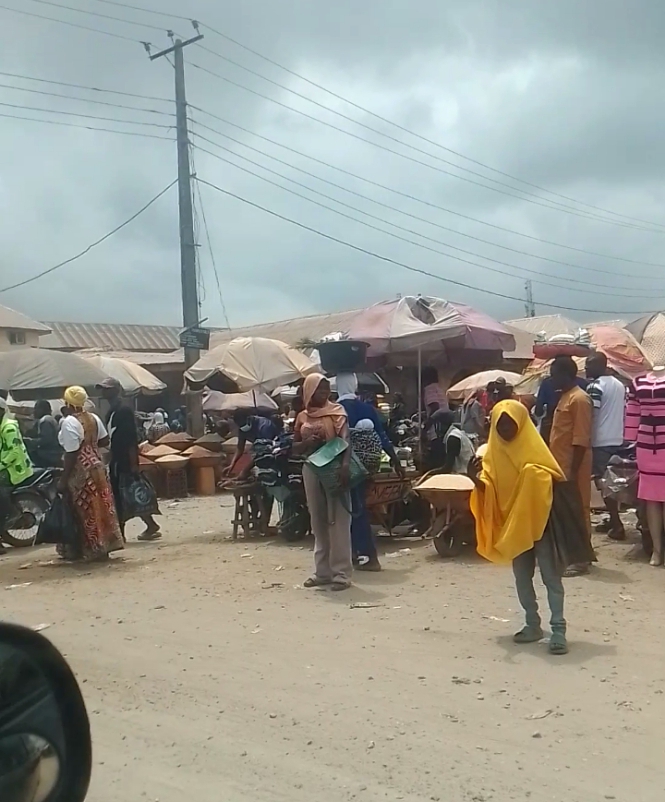
Joke also told us about the relatively low prices of foodstuffs in Osogbo and its environs. We took a stroll to Owode-Ede market on a cool evening and saw this for ourselves. Fruits such as bananas, pineapples and eggplants were not only abundant but also relatively affordable.
Political Atmosphere Before Election Day
The political atmosphere we encountered from Ikire to Osogbo did not reflect the tense picture portrayed on social media.
Indeed, before leaving Ibadan, some people who knew about our trip were deeply concerned and had prayed for our safety. It felt as though we were heading into a danger zone. Nevertheless, we ignored the fears and embarked on the journey.
The atmosphere in Osogbo suggested that residents were determined to make a statement on election day. With Friday declared a public holiday, and perhaps because of uncertainty about what the election might bring, many residents appeared to be making efforts to stock their homes with food.
We witnessed no harassment while driving around Osogbo on Friday.
Accord and APC Secretariats
The secretariats of two of the major political parties, Accord and the All Progressives Congress (APC), are located in Osogbo and are not too far apart.
While the APC secretariat was busy with vehicles and party members, the Accord secretariat appeared deserted. Its doors were shut and we did not see anyone around the premises.
We drove past the APC secretariat, only to learn after returning to our base that about six APC governors and other party stalwarts had been in the state to support the party’s governorship candidate.
The presence of APC supporters at strategic locations during the final stages of the campaign on Thursday, August 13, was noticeable. The charged atmosphere and APC posters across parts of the city initially gave us the impression that Accord might struggle to make significant inroads.
One of the concerns often associated with elections is the possibility of voters being pressured or intimidated into abandoning queues in areas regarded as strongholds of particular political parties.
With this in mind, we spoke with the INEC spokesperson in Osun State, Mr Musa Olumide, at the Osogbo secretariat on the eve of election day.
Asked whether such incidents could occur during the election, he said the people were more politically aware and that the electoral body was prepared to deal with such tactics.
He also addressed concerns about misinformation and tension, which are common during elections in Nigeria.
“It’s an election year, and we are used to tension and rumours, so we should be used to that. The misinformation and disinformation is always rampant in an election year,” he said.
Election Day
We left our lodge at about 7am and headed to the NUJ secretariat, where we had hoped to join other journalists monitoring the election.
The road from Owode-Ede to Oke Fia and the NUJ secretariat was largely deserted, with the curfew in effect.
Our team accommodated the Publisher of Rainbow Magazine, Lagos, Mr Niyi Johnson, and his cameraman in our vehicle so that we could monitor the election together.
Our first port of call was the Osun State Police Command, where we interviewed the Commissioner of Police, CP Samuel Etaifo Erale. He assured residents of a peaceful election and said more than 30,000 police officers had been deployed across the state.
After monitoring voting at nearby polling units, we proceeded towards Ede, where we observed voters turning out in large numbers.
Across several polling units visited in Osogbo and Ede, there were queues of voters waiting to cast their ballots. We did not witness any major incident of violence at the polling units we visited, nor did we directly observe vote-buying.
Security personnel were generally cautious and polite. The heaviest roadblock we encountered was around the INEC secretariat, although accredited journalists and others on official electoral duties were allowed through.
Encounter With a Self-Acclaimed Barrister
An individual who introduced himself as a barrister joined a group of observers monitoring the election in a minibus painted in Osun State transport colours.
The group prevailed on our team, through Mr Johnson, to accompany them. Their precise mission was initially unclear.
The man introduced himself as a barrister and spoke in a manner that suggested he had spent considerable time abroad. We arrived with him at a polling unit in Osogbo, where, within minutes, he began raising his voice and demanding the attention of the INEC Presiding Officer.
The reason for his outburst was initially unclear, even to the journalists accompanying him.
We later heard him questioning the Presiding Officer about why a form had been placed under a file rather than being handed directly to voters whom he claimed had requested it.
The situation quickly became tense as some voters complained about his conduct.
An elderly man challenged him, asking: “Who exactly are you? Show us your ID card.”
Other voters joined in and demanded that he identify himself.
The police officers stationed at the polling unit initially did not question his identity, apparently because he had arrived with us and was wearing an INEC tag. When one of the officers eventually asked him to produce identification, he said he was a barrister but claimed that he had left his identification card at home.
He subsequently moved towards a journalist who was recording the incident, apparently seeking to position himself close to the camera as the situation became more tense.
The man was eventually booed away from the polling unit. With our intervention, the situation did not escalate into a physical confrontation.
We subsequently insisted that he identify himself properly and leave the immediate area before the situation could deteriorate further.
He told us that he was from Ogbomoso and was associated with one of the leading political parties in the election. According to him, his mission was to ensure that his party was not unfairly denied victory.
He was dressed in a black suit. We also observed what appeared to be an alcoholic odour around him, although we cannot independently establish whether he had consumed alcohol.
After several appeals, we directed him towards our Siena minibus and drove him away from the immediate area before asking him to alight at Oke Fia.
Election Observers and the Hustle Culture
Anyone familiar with Nigerian elections will recognise individuals wearing khaki jackets, branded T-shirts and carrying bags or files while identifying themselves as election observers.
Among the established organisations involved in election observation are the Centre for Media and Society, International Press Centre, Nigerian Women Trust Fund, TAF Africa, The Kukah Centre and YIAGA Africa, among others, including organisations operating under the European Union Support to Democratic Governance in Nigeria Election Observation Hub (EU-SDGN EOH), as well as Kimpact Development Initiative (KDI).
These organisations should, however, not be confused with every individual who appears at a polling unit wearing an observer jacket or accreditation tag.
During our assignment, we encountered individuals whose activities raised questions about their actual purpose at polling units.
The group that accompanied the man who introduced himself as a barrister was one such example.
We became more concerned about their activities when we reached an area around Oke Fia, known locally as Olaoye or Adeoye.
The leader of the group approached us and urged us to move to another location, claiming that party agents were sharing money there.
He reportedly said:
“Let’s go there, party agents are sharing money there. If we catch them red-handed, we will be able to collect our own share. That’s how I made good money during the last council election in the Federal Capital Territory.”
At that point, it became clear to us that our purpose for monitoring the election was fundamentally different from theirs. We therefore parted ways.
At a press conference organised by Kimpact Development Initiative on the afternoon of election day, a journalist with Kaftan TV also raised concerns about the conduct of some individuals presenting themselves as election observers.
The journalist said he had seen some observers at the homes of politicians, where, according to him, they ate, drank and appeared to leave with money.
Responding to the concern, a KDI official said individuals found in such compromising circumstances were likely to be fake observers and not accredited by INEC.
Policeman’s Failed Attempt to Take Ballot Box
By about 4pm on election day, several voters were still in queues waiting to cast their ballots in different polling units across Osogbo and Ede.
Our return to Aisu Junction, Alajue Ward 1, Polling Unit 010, opposite Seventh Day in Ede South Local Government Area, however, produced one of the most dramatic moments of our election assignment.
We arrived at about 6pm and found scores of voters waiting for collation to commence.
A member of Governor Adeleke’s family was also seen at the location, seated with an aide and other people around her.
The votes had been counted and Accord was declared the winner at the polling unit.
Not long afterwards, gunshots were heard from the main Gbongan-Ede road. Voters became alarmed and a stampede was narrowly avoided as some people began retreating towards their homes.
Within minutes, a police officer moved towards one of the ballot boxes, grabbed it and ran towards a metallic-coloured Toyota Camry, apparently attempting to leave the area with it.
Some young men who had remained at the polling unit pursued the officer and, amid the confusion, recovered the ballot box and returned it to the INEC officials.
A scuffle subsequently broke out as some youths attempted to confront the policeman. His colleagues and other security personnel intervened and swiftly moved him away from the scene in a patrol vehicle.
We could not independently establish the identity of the officer or his motive for attempting to take the ballot box.
The development created considerable tension and briefly threatened to degenerate into a breakdown of law and order.
However, elders and other members of the community intervened, appealing to the youths to remain calm and preventing the situation from escalating further.
Osogbo Erupts in Jubilation
After the incident, the polling unit gradually emptied as voters returned home.
Few people were seen around parts of the town amid concerns about possible violence.
Meanwhile, election results began to trickle in as INEC uploaded results to its IReV portal. By midnight, indications from results available to the public suggested that the incumbent governor, Ademola Adeleke, was heading towards victory.
At the INEC collation centre, only accredited media organisations were allowed into the premises. Soldiers were stationed at the entrance and used a list of accredited journalists to control access.
By about 8am, Osogbo had erupted in jubilation as results were announced and the winner declared.
Churches near our lodge could be heard singing and praising God in thanksgiving.
A calm atmosphere returned to Osogbo and its environs, even as people of different ages filled the streets, chanting in celebration.
Among the chants heard was:
“Owó wọ̀gbó, owó wọ̀gbó, 50 tásàn, owó wọ̀gbó.”
We also heard claims that some security personnel deployed to the state had been brought in from outside Osun. We could not independently verify those claims.
The Journey Back to Ibadan
On our way back to Ibadan on Sunday afternoon, the roadsides were crowded with commuters returning to their various destinations.
Some had travelled to Osun for the election from places including Lagos, Ghana, Côte d’Ivoire and the Republic of Benin.
A commuter and indigene of Osogbo whom we picked up around the Owode-Ede market area told us that he and other supporters of an opposition party, whose name we are withholding, had been directed by party leaders in Abuja to travel to Osun to vote and support their party’s candidate.
According to him, however, his experience in Osogbo changed his perception of the election.
He said his grandmother and mother had strongly urged him to vote for Imole, the political identity associated with Governor Adeleke.
He recalled that the repeated songs and dancing at home eventually influenced his decision.
Another passenger in our vehicle, a Muslim, dismissed the impact of a reported press conference by some individuals who identified themselves as Islamic clerics and scholars and who reportedly urged Muslims in Osun to support the APC candidate.
He said that, although he was a Muslim, he would not follow such a directive because he had already made up his mind about the candidate he intended to support.
From Osogbo through Ede, Gbongan and Ikire, the Imole movement was visibly dominant, with supporters wearing yellow Accord-coloured caps occupying roads and streets and celebrating what they regarded as the victory of their candidate.
For us, the Osun election was more than the statistics, political speeches and social-media narratives that preceded it.
It was an experience of contrasts: anxiety before the journey, calm encounters with residents, a vibrant electorate, the ubiquity of digital banking, tense moments at polling units, questionable activities by some individuals posing as observers, a disturbing ballot-box incident and, ultimately, widespread celebration after the declaration of the result.
These were the moments we saw, heard and felt as journalists on the ground during the Osun governorship election.